
Danish Telescope observatory

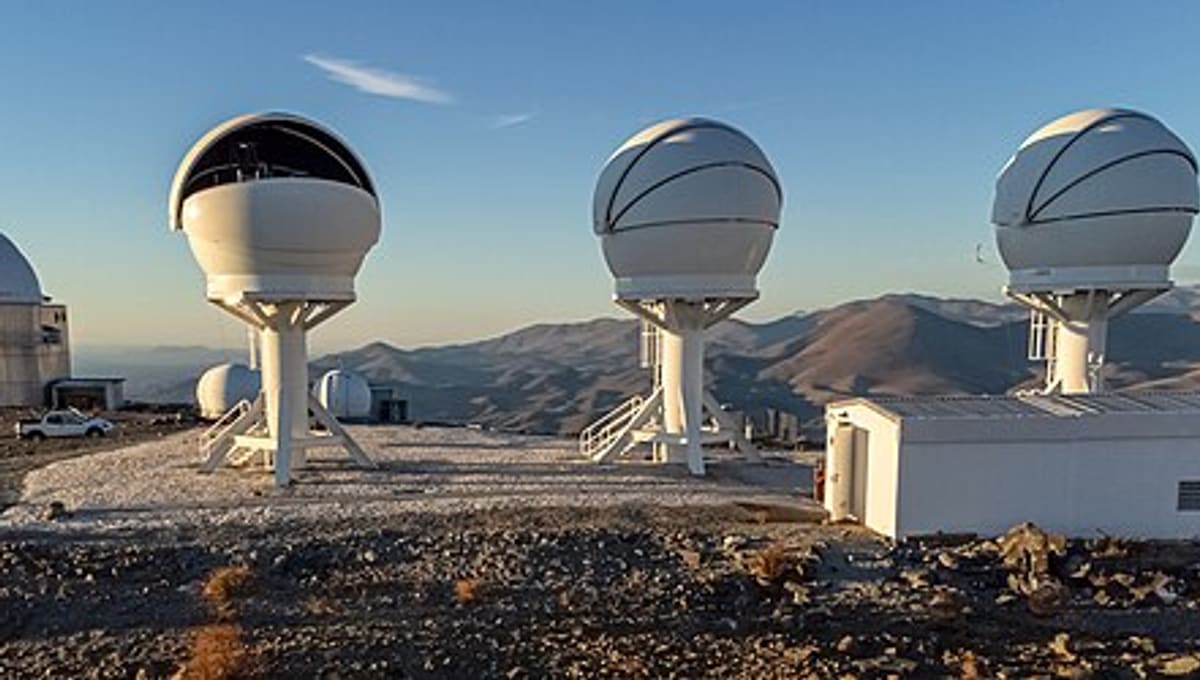
Image: Wikimedia Commons
The Danish telescope sits among the domes of La Silla Observatory in Chile's Atacama Desert, where Denmark has kept a research telescope running since 1979. At 1.54 meters across, it's modest by modern standards, but it's helped uncover some of the most violent and subtle events in the universe, from neutron star collisions to a planet a few times the size of Earth.
About the Danish telescope observatory
The Danish 1.54-metre telescope is one of several instruments hosted at La Silla Observatory, the European Southern Observatory's original Chilean site. Denmark joined ESO in 1967 and contributed this telescope as part of that membership, giving Danish astronomers a permanent foothold on one of the world's premier observing sites.
History
Built by the British firm Grubb-Parsons, the telescope became operational in 1979 and underwent a complete overhaul in 1993 to keep it competitive with newer instruments arriving at La Silla. It remains equipped with the Danish Faint Object Spectrograph and Camera (DFOSC), used for both imaging and spectroscopy of faint objects.
Telescopes & research
Despite its relatively small mirror, the Danish telescope has been behind some notable discoveries. In 2005 it contributed to research suggesting that certain gamma-ray bursts come from merging neutron stars rather than collapsing massive stars. In 2006, observations with the telescope helped detect an exoplanet of roughly five Earth masses orbiting its star over a ten-year period, one of the lower-mass planets found at the time.
Location & getting there
La Silla Observatory sits in Chile's Atacama Desert, about 600 km north of Santiago, at an altitude of roughly 2,400 meters, an elevation and dryness that make it one of the clearest, darkest observing sites on Earth. The Danish telescope's dome is part of the broader La Silla site in the South America region.
Visiting the Danish telescope observatory
La Silla Observatory runs public tours on a limited schedule as part of ESO's outreach program. Because access to individual telescopes like the Danish 1.54-metre depends on the current tour route and observing schedule, it's best to check ESO's official visitor information before planning a trip.
See your named star from here
A telescope that can spot a distant exoplanet or trace a gamma-ray burst back to colliding neutron stars can certainly find one named star. When you name a star with star-register.eu, you get its exact coordinates, ready for any observatory, La Silla included, to point toward. Browse the sky we've already mapped in our star catalogue.
Opening hours and public-visit programs vary by season. Check Google Maps for current times before you travel.
Institutional and reference sources used to verify this guide.
Satellite imagery: Esri, Maxar, Earthstar Geographics

 under 1 km
 27 km
27 km
 27 km
27 km