
Cambridge Bay Magnetic Observatory
Satellite imagery: Esri, Maxar, Earthstar Geographics
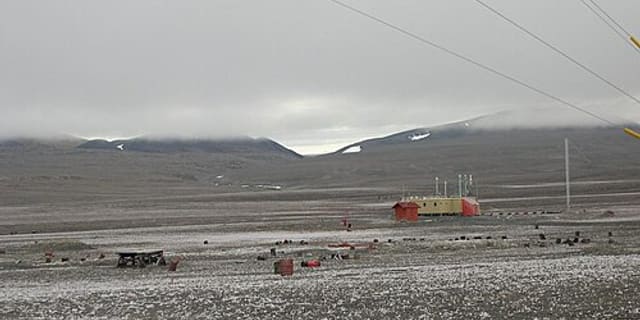
Cambridge Bay Magnetic Observatory is a geomagnetic research station in Cambridge Bay, Nunavut, in Canada's high Arctic.
About Cambridge Bay Magnetic Observatory
Unlike an astronomical observatory built for stargazing, this is a magnetic observatory that measures the strength and direction of Earth's magnetic field. It is operated by the Geological Survey of Canada and is one of 14 Canadian magnetic observatories currently in operation.
History
The building was completed in December 1971, with recording beginning in April 1972, replacing earlier fluxgate magnetometer readings that had been taken from 1968. The current instrumentation, CANMOS (Canadian Magnetic Observatory System), was installed in early 1992, replacing older AMOS systems, and includes a tri-axial ringcore fluxgate magnetometer and an Overhauser Proton Precession Magnetometer.
Telescopes & research
The station sits under the magnetospheric cleft region, making it a valuable site for studying disturbances in Earth's magnetosphere as well as its baseline magnetic field.
Location & getting there
Cambridge Bay is a remote community in Nunavut, in Canada's Arctic, within the North America region — a location chosen for its scientific value rather than easy access.
Visiting Cambridge Bay Magnetic Observatory
As a scientific monitoring station, no public tour information is published; the Geological Survey of Canada's geomagnetism page has technical details for those interested in its data.
See your named star from here
Cambridge Bay watches the Earth's magnetic field rather than the night sky, but its remote Arctic setting sits under dark skies where a named star's coordinates could, in principle, still be tracked down. Browse our star-naming packages or the star catalogue to name your own.
Opening hours and public-visit programs vary by season. Check Google Maps for current times before you travel.
Institutional and reference sources used to verify this guide.
Satellite imagery: Esri, Maxar, Earthstar Geographics

 1,791 km
 2,089 km