
Burjassot Observatory
Satellite imagery: Esri, Maxar, Earthstar Geographics
Burjassot Observatory is the Astronomical Observatory of the University of Valencia (OAUV), one of the oldest active university observatories in Spain.
About Burjassot Observatory
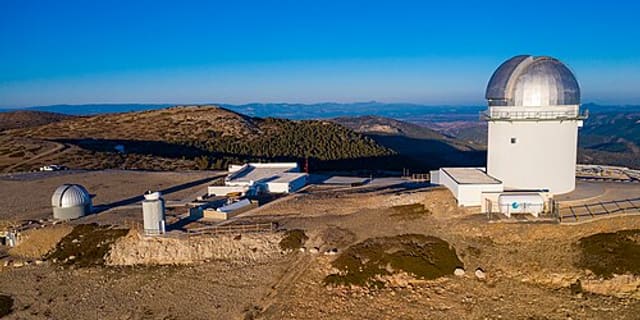
The observatory's headquarters are based at the University of Valencia's Science Park in Paterna, while its observational facilities sit further inland at Aras de los Olmos, on the Muela de Santa Catalina mountain, at an elevation of around 1,280 metres. From there it contributes to international research collaborations, including the Event Horizon Telescope project responsible for the first images of a black hole.
History
Burjassot Observatory was founded in 1909 by Dr. Ignacio Tarazona Blanch and was declared of public utility by King Alfonso XIII in 1920, making it Spain's oldest active university observatory.
Telescopes & research
The observatory operates five telescopes, with apertures of 60, 52, 40, 30 and 14 cm, used for spectroscopy, photometry, astrometry, transient detection and wide-field deep imaging.
Location & getting there
While the university headquarters are in Paterna, the observing station itself is located about 100 km inland at Aras de los Olmos, high on the Muela de Santa Catalina mountain in Spain's Valencian Community.
Visiting Burjassot Observatory
For current public visiting arrangements at either the Paterna headquarters or the Aras de los Olmos observing site, check with the University of Valencia's observatory pages before planning a trip.
See your named star from here
An observatory that helped image a black hole across the world's telescopes knows precisely how to work with sky coordinates — exactly what comes with a star named through Star Register. Name a star or browse the catalogue.
Opening hours and public-visit programs vary by season. Check Google Maps for current times before you travel.
Institutional and reference sources used to verify this guide.
Satellite imagery: Esri, Maxar, Earthstar Geographics

 78 km
78 km