
Murcia Observatory
Satellite imagery: Esri, Maxar, Earthstar Geographics
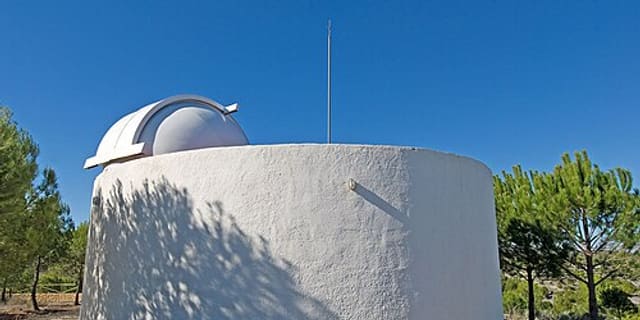
In the Carrascoy mountains near Murcia, Spain, La Murta Observatory has spent over two decades tracking asteroids and comets from its home in the region's dark mountain skies.
About Murcia Observatory
Known primarily by the name of its main facility, La Murta Observatory, the site carries the Minor Planet Center code J76 and has built a research relationship with organisations including the Institute of Space Sciences (CSIC-IEEC) and the Instituto de Astrofísica de Canarias (IAC). Its observations have even fed into NASA's Deep Impact and Dawn missions.
History
Systematic asteroid and comet research began at the site in 2001, the same year a second facility, the Cabezo de la Jara Observatory, opened nearby.
Telescopes & research
La Murta Observatory's main instrument is a 16-inch Meade Schmidt-Cassegrain telescope, used for its ongoing asteroid and comet monitoring programme. The nearby Cabezo de la Jara Observatory adds a 12-inch Meade LX200 reflector, and both sites also support public sky-watching and educational visits.
Location & getting there
The observatory sits in the Carrascoy mountain range near the city of Murcia, in southeastern Spain - a setting that lifts it above the region's coastal light pollution.
Visiting Murcia Observatory
Both La Murta and Cabezo de la Jara host educational visits and dissemination events for the public alongside their research work. Check locally for current session dates and booking details before you travel.
See your named star from here
An observatory built to track faint, moving asteroids has more than enough precision to find the fixed coordinates of a named star. If you've named one through star-register.eu, look up its position in our catalogue, or start a new naming through our packages and ask about viewing it on your next visit.
Opening hours and public-visit programs vary by season. Check Google Maps for current times before you travel.
Institutional and reference sources used to verify this guide.
Satellite imagery: Esri, Maxar, Earthstar Geographics

 80 km
80 km
 149 km