
ATLAS–MLO observatory


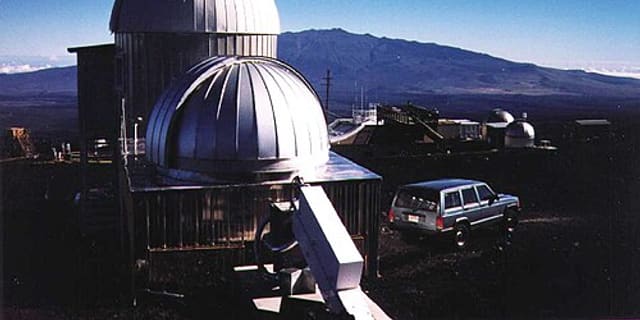
Image: Wikimedia Commons
ATLAS–MLO is the second Hawaiian station of the ATLAS asteroid-detection network, sited high on Mauna Loa's slopes on the Big Island, 160 km from its sister telescope at Haleakalā.
About ATLAS–MLO observatory
ATLAS–MLO was deployed in March 2017 as the second telescope of the Asteroid Terrestrial-impact Last Alert System (ATLAS), a NASA-funded robotic survey run by the University of Hawaii's Institute for Astronomy that watches for small near-Earth asteroids in the days or weeks before a possible impact. Working together with its twin unit on Haleakalā, 160 km away, it helps ATLAS cover roughly half the visible sky every clear night. The station sits at about 3,408 metres elevation and carries the Minor Planet Center code T08.
Telescopes & research
Like its sister stations, ATLAS–MLO uses a 0.5-metre Wright-Schmidt telescope with a very wide field of view and a large CCD camera, built to photograph broad regions of sky in a single frame rather than a narrow target. Beyond spotting potentially hazardous asteroids, the ATLAS network has also discovered thousands of supernovae and other transient events and tracks comets and variable stars.
Location & getting there
ATLAS–MLO sits high on the northern slope of Mauna Loa on Hawaii's Big Island, near the long-running NOAA Mauna Loa Atmospheric Baseline Observatory. The narrow, one-lane Mauna Loa Observatory Road that serves the area was buried by lava during Mauna Loa's 2022 eruption; a temporary road was rebuilt by 2026, though facility infrastructure is still being restored.
Visiting ATLAS–MLO observatory
ATLAS–MLO is an unattended, robotically operated telescope with no public visiting programme. Wider public access to the Mauna Loa summit area has also been limited following the 2022 eruption, so check current NOAA and county notices before planning any trip up the mountain.
See your named star from here
Mauna Loa's altitude and clean air are exactly why astronomers picked it — the same coordinates that guide ATLAS's asteroid searches can guide a telescope to your named star. Name a star for its RA/Dec and certificate, then check the catalogue or find another observatory on the Big Island.
Opening hours and public-visit programs vary by season. Check the official website and Google Maps for current times before you travel.
Institutional and reference sources used to verify this guide.
Satellite imagery: Esri, Maxar, Earthstar Geographics

 under 1 km
 34 km
34 km
 34 km
34 km
 34 km
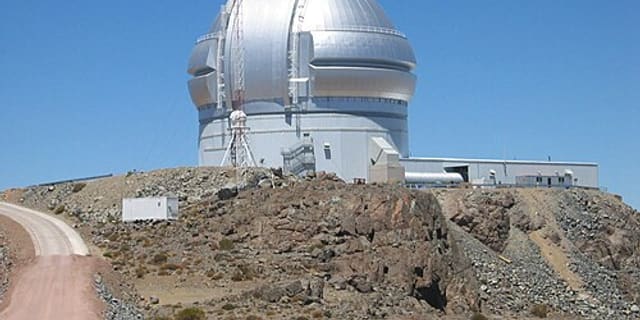
34 kmGemini Observatory
astronomical observatory consisting of twin telescopes in the north and south hemispheres