
What kind of star is Mira?
Mira, catalogued as Omicron Ceti (ο Cet), appears in the official constellation Cetus. Its apparent visual magnitude is variable; typically about 2–10 in visible light, while its estimated distance is about 300 light-years. Astronomers classify the object as M5–M9 IIIe AGB star + white-dwarf companion. These labels describe temperature, luminosity class or system components; they should not be read as a claim that every naked-eye point is a single isolated star.
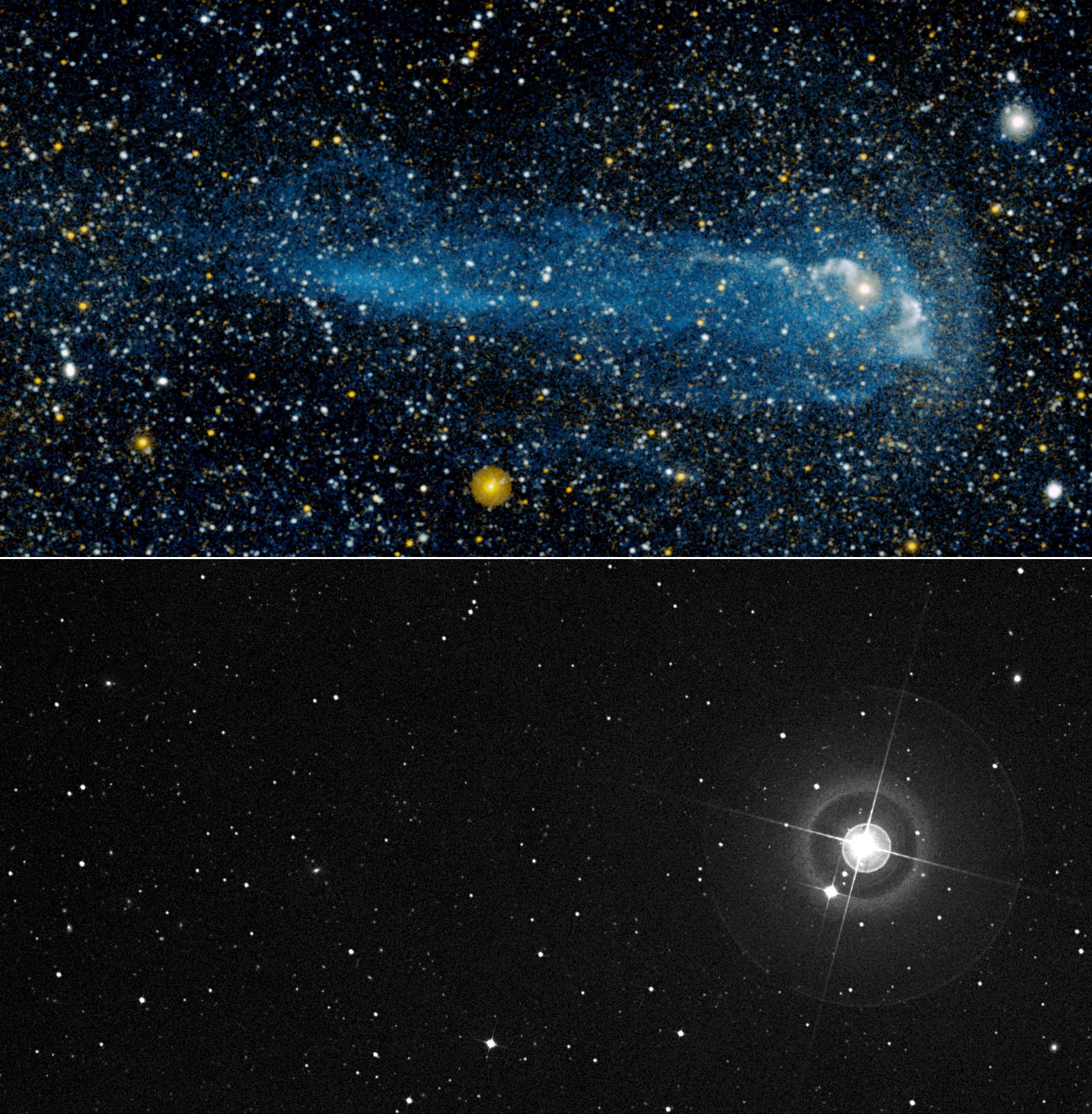
Mira A is an asymptotic-giant-branch star undergoing large radial pulsations with a mean period near 332 days. Temperature changes and titanium-oxide absorption amplify its enormous visual range, so visible brightness varies more dramatically than total energy output. A white-dwarf companion, Mira B, accretes material from the giant's wind in a system separated by tens of astronomical units. NASA's GALEX mission discovered a comet-like ultraviolet tail extending roughly 13 light-years behind the system as it moves through interstellar gas, plus a bow shock ahead of it. The SIMBAD parallax implies a distance near 300 light-years. Mira is losing the envelope that can later illuminate a planetary nebula while its core ultimately becomes a white dwarf.
The coordinate pair RA 02h 19m 20.79s, Dec −02° 58′ 39.5″ fixes the object's direction on the celestial sphere for the J2000 reference epoch. Right ascension works like celestial longitude measured in hours, while declination works like latitude north or south of the celestial equator. Proper motion and improved measurements can refine catalogue positions, but these coordinates are sufficiently precise for a finder chart or planetarium search.
Mira data at a glance
| Proper name | Mira | Catalogue designation | Omicron Ceti (ο Cet) |
|---|---|---|---|
| Constellation | Cetus | Apparent magnitude | variable; typically about 2–10 in visible light |
| Spectral or system type | M5–M9 IIIe AGB star + white-dwarf companion | Estimated distance | about 300 light-years |
| Right ascension (J2000) | 02h 19m 20.79s | Declination (J2000) | −02° 58′ 39.5″ |
Values are rounded for an observer-friendly overview. Consult the linked SIMBAD record for component-level identifiers, bibliography, measurement provenance and newer catalogue values.
The name Mira
Latin mira means “wonderful” or “astonishing.” Johannes Hevelius applied the name after the star's repeated disappearance and return became clear.
David Fabricius recorded Mira in 1596 while observing Mercury, then saw it disappear and return. Earlier East Asian records may describe the same region, but individual identifications require caution. Hevelius named it Mira in the seventeenth century. The star became the prototype of an entire class and remains one of the AAVSO's most important long-baseline visual targets. Its recurring visibility helped overturn the old assumption that the supposedly fixed stellar sky could not undergo conspicuous change.
Modern professional catalogues retain identifiers such as the Bayer designation alongside a proper name. The International Astronomical Union standardizes which name belongs to which component—an important distinction for systems whose combined light looks like one star from Earth.
How to find Mira
Use a current AAVSO chart and prediction rather than assuming Mira is visible. Near maximum it can join Cetus's naked-eye pattern; near minimum it may fall below ordinary binocular reach. Make estimates against calibrated comparison stars every week or two.
Potentially naked-eye near favourable maxima, but it spends much of each 332-day cycle requiring binoculars or a telescope. Visibility on a particular night still depends on latitude, season, time, horizon obstructions, weather and local light pollution. Use the interactive atlas below to check the surrounding field before observing.
Observation checklist
- Check the current light curve before planning an observation.
- Use the same instrument and comparison sequence across a cycle.
- A red-sensitive camera records a different amplitude from the eye.
- Do not confuse the 332-day mean period with an exact repeating timetable.
Interesting facts about Mira
- Mira defines the Mira class of long-period variables.
- Its mean pulsation cycle is about 332 days.
- Mira B is a white-dwarf companion accreting from the giant's wind.
- GALEX revealed an ultraviolet tail about 13 light-years long.
- Its visual amplitude is enhanced by temperature-sensitive molecular absorption.
Continue from Mira into the night sky
Use the Cetus constellation guide to place this star within its larger pattern. When you are ready to observe, compare dark-sky places, find a nearby observatory, or follow our practical guide to finding a star in the night sky. Symbolically registered names are kept separately in the searchable Star-Register catalogue.
Sources and further reading
Measurements are rounded for readability. Multiple systems, variable stars and distant supergiants can have component-specific or model-dependent values. Survey panels show photographic sky fields, not the physical surface of the star.