

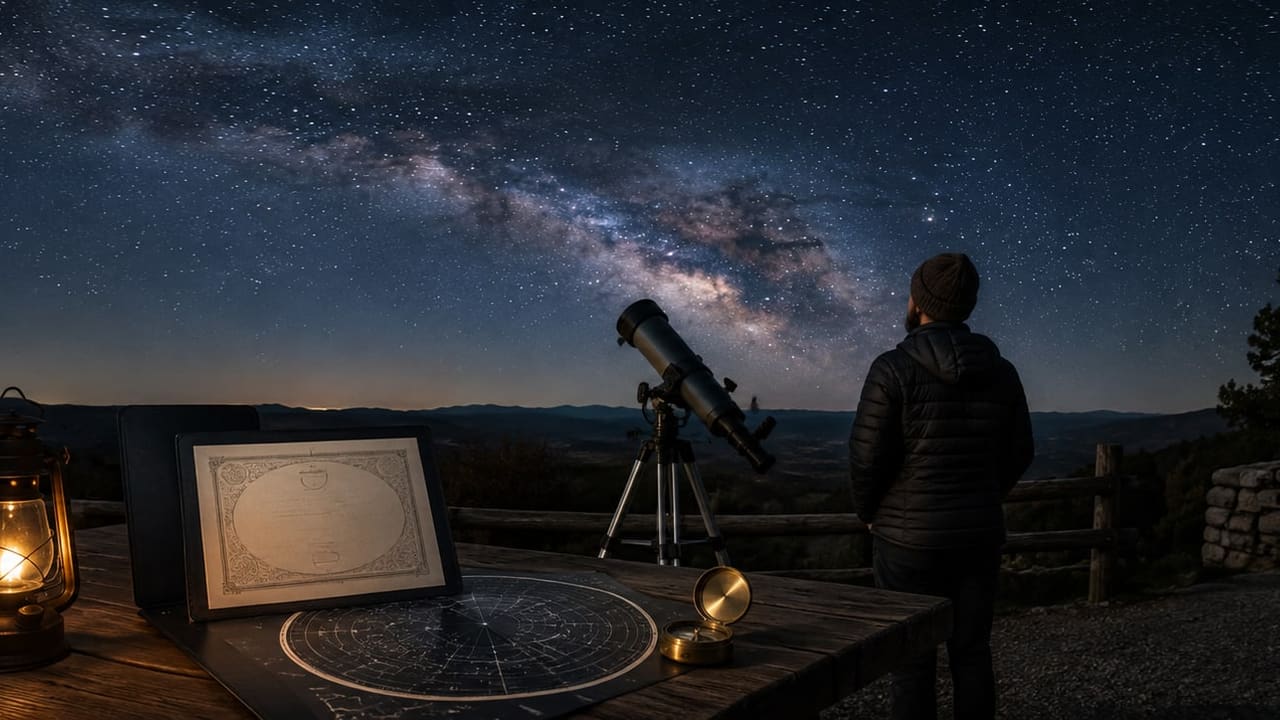
To adopt a star usually means creating a symbolic dedication or sponsoring an astronomy programme. You are not purchasing the physical star, and the personal name does not replace its scientific designation. Depending on the programme, you may receive a certificate, real celestial coordinates, a star map, a searchable record or even an observatory visit.
Quick answer: choose what kind of adoption you want, check exactly where the money goes, select a real catalogued star, add the name or dedication and confirm the certificate and finding tools before paying. Simple digital options can start around $10–$50, while physical gifts, bright-star upgrades and observatory experiences can cost substantially more. NASA does not sell or adopt stars for the public.
- Symbolic star dedication: a chosen name is associated with a real star in a private register.
- Research sponsorship: a nonprofit assigns a star while the payment supports astronomy work.
- Observatory fundraiser: an observatory may combine a certificate with tours, education or public outreach.
- Not ownership: none of these transfers the star or creates an official scientific name.
- Not a NASA service: a programme may use NASA-observed targets without being operated or endorsed by NASA.
What does it mean to adopt a star?
“Adoption” is not a single astronomical or legal process. It is an umbrella term used by gift companies, nonprofits, museums and observatories. The star itself remains a celestial object that nobody can carry away, control or privately rename for science. What changes is the human record or programme attached to it.
| Type of adoption | What you receive | Where the payment goes | What it does not provide |
|---|---|---|---|
| Private symbolic dedication | Personal certificate, coordinates, star map, private registry entry and often an app | To the commercial provider for the service and gift materials | Scientific naming rights or ownership |
| Nonprofit research sponsorship | Adoption certificate and a page or record for a research target | To the named nonprofit or research activity, after stated costs | Control over the research or scientific name |
| Observatory adoption | Certificate and, in some programmes, a tour, viewing session or educational materials | To observatory operations, education or public outreach | International naming rights |
A private dedication is usually the easiest option for a personalised gift because you can choose the name, date, message, format and sometimes the constellation. A science sponsorship may suit someone who cares most about research impact. An observatory programme is often more expensive but can turn the adoption into a real night of observing.
This distinction matters when comparing offers. Two pages may both say “adopt a star” while selling very different experiences. Read the promise, the recipient of the payment and the contents of the package—not just the headline.
How to adopt a star in seven steps
1. Decide what you want the adoption to achieve
Start with the recipient. For a birthday, anniversary or memorial, a personalised certificate and an easy way to locate the star may matter most. For a keen astronomy supporter, a research donation or observatory experience may be more meaningful. This decision narrows the market immediately.
2. Choose the programme type
Check whether the provider is a commercial registry, registered nonprofit, museum or observatory. If it says proceeds support research, look for the legal organisation, the named project and a clear explanation of how funds are used. If it is a gift service, check its delivery, corrections and refund terms.
3. Check that the star is identifiable
A useful adoption points to a genuine astronomical object. Look for right ascension and declination, a recognised scientific catalogue identifier such as HIP, HD, TYC or Gaia, and the constellation. Those details let you distinguish the real star from the personal dedication. Our guide to how star naming works explains what each certificate field means.
4. Select a star or sky region
Some services assign the next available star; others let you choose brightness, a binary pair or a constellation. A constellation connected to a birth month, shared memory or favourite story gives the gift context. Browse the constellation directory before paying for a location upgrade.
5. Add the dedication carefully
Enter the display name, dedication date and personal message exactly as they should appear. Check spelling, accents, capitalisation and date format. Ask whether digital documents can be corrected and whether reprinting or reshipping a physical certificate costs extra.
6. Review the final price and contents
Confirm whether the advertised amount includes the certificate, registry entry, sky map, app access, tax and delivery. A cheap starting price can rise after constellation, brightness, framing and express-shipping upgrades. See our complete star price comparison for realistic gift budgets.
7. Save the record and locate the star
Keep the confirmation email, registration number, coordinates and catalogue ID together. Open the coordinates in a planetarium app or scientific database, then use the map from a suitable observing site. The adoption becomes more memorable when the recipient can connect the certificate to a point in the real sky.
How much is it to adopt a star?
The cost depends more on the programme than on the star. Digital symbolic gifts commonly occupy the lower end of the market, while physical packages, research sponsorships and observatory experiences add different kinds of value. The examples below were checked on 7 September 2026 and should be treated as dated examples, not permanent quotes.
| Example | Price checked | What the payment represents |
|---|---|---|
| Private digital dedication | Often about $20–$50 | Registry entry, personalised PDF certificate, coordinates and finding material |
| Private physical gift | Often about $40–$100+ | Digital service plus printed presentation, packaging and delivery |
| Star Registration folder set on Amazon | Check current Amazon price and availability | Personalised certificate, real coordinates, registration number, star map, sky atlas, finding guide and presentation folder |
| Nonprofit Adopt a Star | $10 target star; $15 double; $25–$50 planetary system; $100 bright star | Digital adoption linked to a research target; proceeds support the organisation's astronomy work |
| Space Place, Wellington | NZ$55 single star | Certificate, coordinates, constellation material, supporter model and general-admission pass |
| Perth Observatory, Australia | AU$470–AU$2,070 | Time-limited adoption based on brightness, plus certificate, charts, planisphere and a private tour for four |
The range is wide because these are not equivalent products. A $10 research sponsorship emailed as a certificate should not be compared as if it were the same package as an Australian observatory adoption with a private viewing session. Compare the outcome you want and the complete inclusions.
Costs that are easy to miss
- constellation, brightness or binary-star upgrades;
- printed folders, frames, gift boxes and keepsakes;
- standard or express international shipping;
- sales tax, GST, VAT and currency conversion;
- certificate corrections, replacement prints or extra copies;
- travel to an observatory and accommodation for an included tour.
Use the amount shown immediately before payment as the true comparison price. If the package is time-limited, also check whether renewal is available or required. Many private dedications are advertised as permanent within that provider's registry, while observatory sponsorships may last a set number of years.
Can you adopt a star through NASA?
No. NASA does not operate a public star-adoption or paid star-naming service. NASA's published guidance explains that names sold by private groups are not used by scientific institutions. The International Astronomical Union, not NASA, coordinates internationally recognised astronomical nomenclature—and the IAU does not sell personal star names either.
The phrase “adopt a star NASA” causes confusion because independent programmes may use stars observed by NASA missions. For example, Nonprofit Adopt a Star offers targets observed by the Kepler or TESS space telescopes and planetary systems listed in the NASA Exoplanet Archive. That describes the scientific source of the targets; it does not turn the adoption into a NASA product or endorsement.
A reliable wording test: “star observed by a NASA telescope” can be factually checkable. “Star adopted through NASA,” “NASA-approved name” or “registered with NASA” is not. Read what NASA does—and does not do—with star names before buying.
How to adopt a star in Australia
Australian searchers have two broad choices: order a symbolic star gift online for delivery in Australia, or choose an observatory fundraiser with a local experience. Currency, shipping and visibility from the Southern Hemisphere all deserve attention.
Online symbolic adoption delivered to Australia
Check that the provider can assign a star suitable for the recipient's latitude and displays the full price in a clear currency. A digital certificate avoids international postage. For a physical pack, confirm GST, delivery time, tracking and the sender country before checkout. A provider that lets you select a southern constellation such as Crux, Centaurus or Carina can make the observing experience more relevant.
Perth Observatory Star Adoption
Perth Observatory currently offers a materially different programme. Its published package combines a certificate and finder materials with a private viewing tour for the recipient and three guests. Prices vary with stellar magnitude and adoption duration, from AU$470 for a binocular star to AU$2,070 for the brightest category at the time checked. The observatory explicitly states that the programme does not grant international naming rights; income supports its not-for-profit public outreach.
Do not rely on an old Mount Stromlo listing
The Australian National University's Mount Stromlo page remains online as a historical register, but its Adopt-a-Star programme ended on 31 July 2006. The page is useful history, not a current checkout option. This is why checking the operating date matters when an older institutional page ranks in search.
Is adopting a star legitimate?
It is legitimate when the provider accurately describes the transaction. A symbolic gift can record a unique dedication in a private catalogue. A nonprofit can accept a donation and acknowledge it with a star adoption. An observatory can use adoption income to fund education and access. None of those claims require pretending the recipient owns the star.
The International Astronomical Union says it does not offer a star-naming service and disassociates itself from commercial sales of star names. That does not make a clearly described commemorative gift illegal; it defines the boundary between a personal record and scientific nomenclature.
| Claim | Reasonable interpretation | What to verify |
|---|---|---|
| “Real star” | The coordinates point to a catalogued astronomical object | Catalogue ID and coordinates |
| “Unique adoption” | The programme will not assign that record twice in its own database | Searchable register and uniqueness policy |
| “Permanent” | The provider intends to retain its private record indefinitely | Terms, backups and lookup access |
| “Supports research” | Some or all proceeds fund a stated programme | Legal organisation, allocation and current project |
| “Official name” | Potentially misleading in a commercial context | Whether the IAU recognises it; paid personal names are not IAU names |
How to choose a star-adoption programme
Before entering a name or card number, work through this checklist:
- Identify the operator. Find the business, charity, museum or observatory behind the page.
- Read the scientific-status statement. It should plainly separate a symbolic dedication from an IAU name.
- Verify the star data. Coordinates and a recognised catalogue number should identify the object independently.
- Check the promised record. Look for a registration number, searchable page and uniqueness policy.
- Confirm what arrives. Separate emailed files from printed items, tours and optional extras.
- Check visibility honestly. “Visible” may mean naked eye, binoculars or telescope; magnitude should support the claim.
- Read delivery and correction terms. Personalised products can have special return conditions.
- Verify a donation claim. Confirm the organisation and project rather than assuming “adoption” automatically means charity.
For examples of a private star-dedication approach, compare the explanations from StarRegistration.net and LabelStars. Both should still be evaluated against the checklist above and their live checkout terms.
How do you find an adopted star?
The personal name alone will not work in every astronomy app because private dedications are not scientific designations. Start with the catalogue ID or coordinates supplied with the adoption.
- Find the right ascension, declination and scientific catalogue ID on the certificate or registry page.
- Confirm the object in the provider's finder, SIMBAD or another astronomy database.
- Set your observing app to the correct location, date and time.
- Use the surrounding constellation and bright guide stars to move toward the target.
- Check its magnitude to determine whether you need the naked eye, binoculars or a telescope.
Our practical guide explains how to find a star from its coordinates. You can also inspect how real entries are presented in the star catalogue and choose a darker observing location from the stargazing directory.
Common questions about adopting a star
How do you adopt a star?
Choose a symbolic gift, nonprofit sponsorship or observatory programme; select an available star; enter the dedication; check the coordinates, catalogue ID and package contents; then complete payment. Save the certificate and use the supplied sky map or astronomy app to locate the target.
How much does it cost to adopt a star?
Digital adoptions can start around $10–$50. Printed star gifts often cost roughly $40–$100 or more. Observatory programmes can cost hundreds or thousands when they include a private tour, public-outreach sponsorship or a particularly bright star. Prices vary by programme and currency.
Can I adopt a star from NASA?
No. NASA does not sell star adoptions or personal names. An independent nonprofit may offer a star observed by NASA's Kepler or TESS missions, but that does not make NASA the seller or adopter.
Will I legally own the star?
No. You receive the provider's dedication, sponsorship acknowledgement or experience—not title to the celestial object. The personal name also does not replace the star's scientific catalogue designation.
Is adopting a star the same as naming one?
Sometimes. Commercial sites often use “adopt,” “name” and “buy” for the same symbolic gift. Nonprofit and observatory programmes may use “adopt” specifically for fundraising, so check the operator and stated purpose.
Can somebody else adopt the same star?
That depends on the programme. Some providers promise uniqueness within their own registry, and some nonprofit databases assign each target once. The same astronomical star can still appear in unrelated private databases because there is no universal commercial adoption register.
Can I adopt a star for free?
You can create a personal dedication or star map yourself, and some community projects may offer free records. A paid programme usually covers database maintenance, certificate design, finding tools, gift materials, a donation or an experience. Check what the fee funds rather than assuming a free and paid option are equivalent.
What should an adoption certificate include?
Look for the dedication name and date, right ascension and declination, constellation, scientific catalogue ID, registration number and clear programme identification. A map or app instructions make the document more useful.
Sources and research notes
This guide separates scientific naming, private dedications and fundraising programmes. Programme details and displayed prices were checked on 7 September 2026.
- International Astronomical Union — Astronomy FAQ: “Can I buy a star?”.
- NASA — History Office policy and FAQ on naming stars.
- United Nations Office for Outer Space Affairs — Outer Space Treaty, including the non-appropriation principle in Article II.
- Nonprofit Adopt a Star — programme types, current prices and research purpose.
- Perth Observatory — Star Adoption and Private Tour.
- Australian National University — historical Mount Stromlo Adopt-a-Star programme.
- Space Place / Wellington Museums — current single-star adoption package.
- Amazon — Star Registration personalised folder set; price and availability can change.
Continue with the complete guide to buying a star-naming gift, learn how star naming works, compare current star-naming costs, or review regional services on the registry partners page.