
Xingming Observatory
Satellite imagery: Esri, Maxar, Earthstar Geographics
Xingming Observatory is a private amateur observatory in Gangou Township, near Ürümqi in China's Xinjiang region, that has quietly become one of the world's most prolific discovery sites for comets, asteroids and exploding stars.
About Xingming Observatory
The observatory was founded in 2007 by amateur astronomer Gao Xing. Its name partly commemorates Zhou Xingming, a pioneer of amateur astronomy in China. Despite being privately run, Xingming Observatory has racked up an impressive discovery record: as of 2024, its team has found 3 comets, 15 asteroids, 90 supernovae, 63 novae and 111 dwarf novae.
Telescopes & research
Three telescopes make up the observatory's main equipment: the NEXT, a 60-cm Ritchey-Chrétien; the HMT, a 50-cm reflector; and the PSP, a 36-cm Schmidt-Cassegrain. These support the observatory's focus on time-domain astronomy and solar system observations, run through the Xingming Observatory Sky Survey (XOSS), which searches for transients, asteroids and comets. The observatory also shares telescope access with the public through its XPRO program, and runs the Popular Supernova Project, a citizen-science initiative done in collaboration with China's National Astronomical Observatories.
Location & getting there
Xingming Observatory sits in Gangou Township, in the hills near Ürümqi, the capital of China's Xinjiang region, a remote setting suited to its dark-sky survey work. Use the map and directions button on this page to plan your route.
Visiting Xingming Observatory
Xingming Observatory is a private facility, but its XPRO program is built around sharing telescope access with the public. Check the observatory's current programs before planning a visit.
See your named star from here
An observatory that has already logged over a hundred supernovae and novae is well equipped to find one more point of light, like a star named through our star-naming packages. Browse the catalogue to see stars already named by our customers.
Opening hours and public-visit programs vary by season. Check the official website and Google Maps for current times before you travel.
Institutional and reference sources used to verify this guide.
Satellite imagery: Esri, Maxar, Earthstar Geographics

 under 1 km
Xinjiang Astronomical Observatory
astronomical observatory in Xinjiang, China
Xingming Observatory #3, Nanshan
astronomical observatory in Xinjiang, China
Nanshan Station, Xinjiang Observatory
astronomical observatory in Xinjiang, China

 753 km
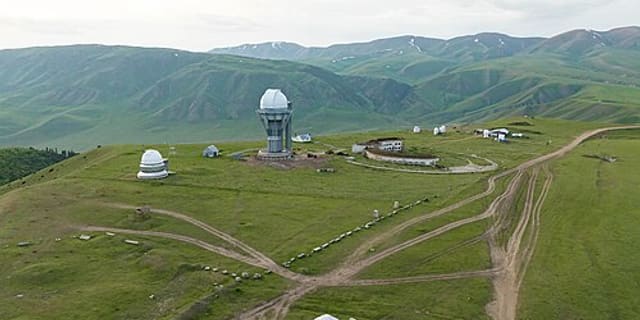
Assy-Turgen Observatory
observatory in Enbekshikazakh District, Almaty Region, Kazakhstan