
Xingming Observatory #3, Nanshan
Satellite imagery: Esri, Maxar, Earthstar Geographics
In the mountains near Nanshan, outside Ürümqi in China's Xinjiang region, Xingming Observatory #3 is a private amateur facility built for round-the-clock sky surveys. Sitting at roughly 2,080 metres above sea level, it has become one of the most productive amateur observatories in Asia for spotting transient events.
About Xingming Observatory #3, Nanshan
Xingming Observatory #3 is a privately run amateur observatory in Gangou Township, near Ürümqi. Its name partly honours Zhou Xingming, an early pioneer of amateur astronomy in China, and the site has grown into a serious hub for time-domain astronomy carried out largely by dedicated volunteers.
History
The observatory was founded in 2007 by amateur astronomer Gao Xing. What began as a personal project has since developed into a facility recognised for its consistent contributions to transient-object surveys, working alongside China's National Astronomical Observatories on citizen-science initiatives.
Telescopes & research
Three telescopes are in regular use at the site: a 0.6-metre instrument known as NEXT, a 0.5-metre Half Meter Telescope (HMT), and a 0.36-metre Schmidt-Cassegrain (PSP). Together they support the Xingming Observatory Sky Survey (XOSS), a programme focused on time-domain astronomy and solar-system monitoring. As of 2024, observers at the site have been credited with discovering three comets, fifteen asteroids, ninety supernovae, sixty-three novae, and 111 dwarf novae.
Location & getting there
The observatory sits at an elevation of around 2,080 metres in Gangou Township, part of the wider Nanshan astronomical site outside Ürümqi in Xinjiang. The high, dry mountain air here is part of why the area has drawn several observatories.
Visiting Xingming Observatory #3, Nanshan
Rather than in-person tours, the observatory is best known for its XPRO programme (Xingming Public Remote Observatory), which lets members of the public book remote observing time on its telescopes. Anyone hoping to visit in person should check current arrangements directly with the observatory before travelling.
See your named star from here
Because Xingming Observatory #3 operates telescopes that can be pointed at precise coordinates, the right ascension and declination of a star named through Star Register can, in principle, be located from a site like this. Browse the full star catalogue to see how coordinates translate into a real point in the night sky.
Opening hours and public-visit programs vary by season. Check Google Maps for current times before you travel.
Institutional and reference sources used to verify this guide.
Satellite imagery: Esri, Maxar, Earthstar Geographics
Nanshan Station, Xinjiang Observatory
astronomical observatory in Xinjiang, China

 under 1 km
Xinjiang Astronomical Observatory
astronomical observatory in Xinjiang, China

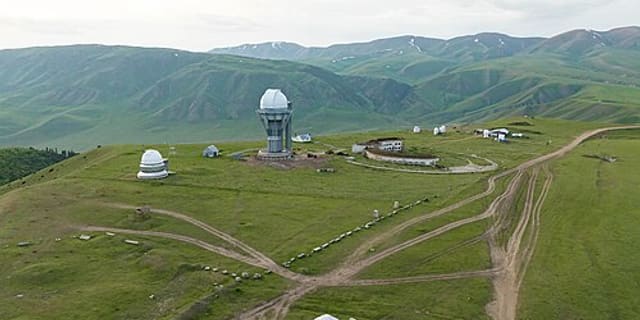 752 km
Assy-Turgen Observatory
observatory in Enbekshikazakh District, Almaty Region, Kazakhstan

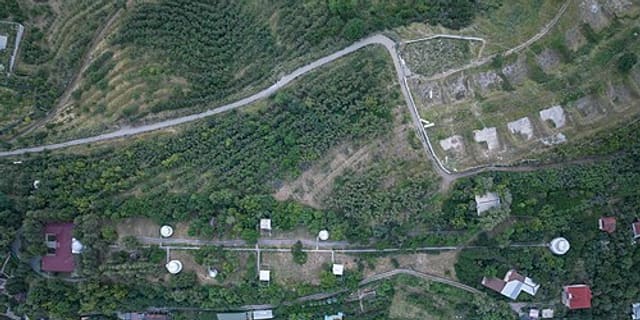 826 km