
Ved Shala

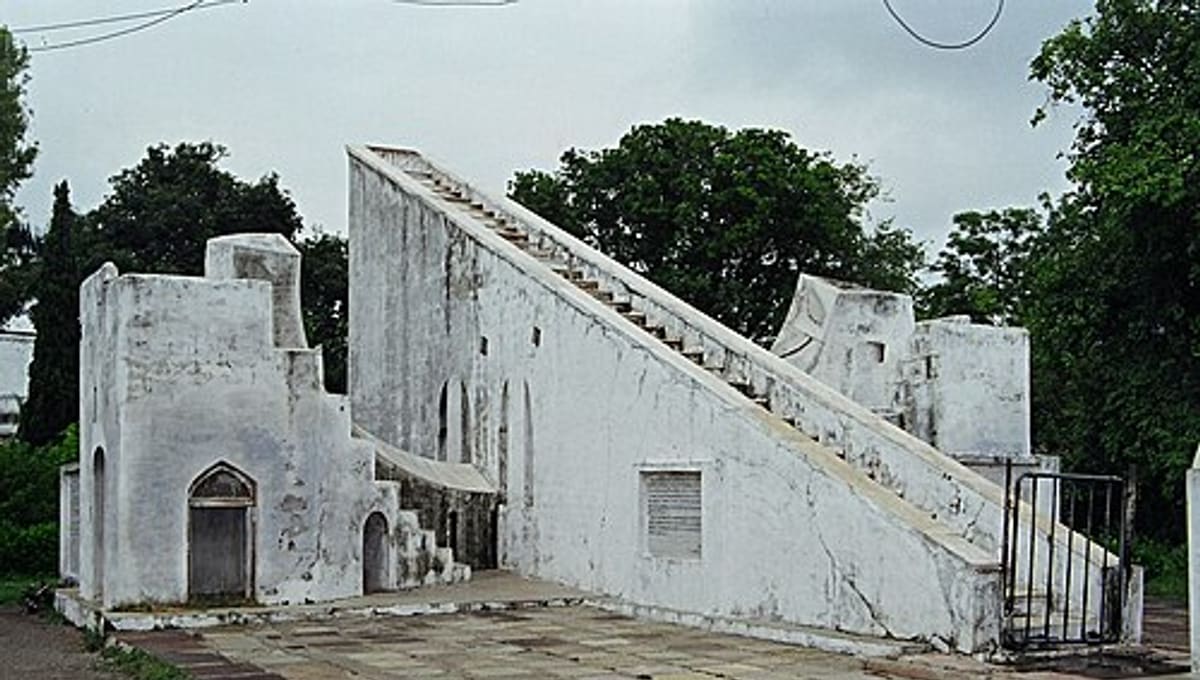
Image: Wikimedia Commons
In Ujjain, a city historically considered the Greenwich of India, Ved Shala's collection of stone astronomical instruments has measured the sky since 1725.
About Ved Shala
Ved Shala, also known as Jantar Mantar in New Ujjain, is an observatory designed to be used with the naked eye. It is one of five Jantar Mantar observatory sites built across India, consisting of 13 architectural astronomy instruments.
History
It was built by Maharaja Jai Singh II in 1725, while he was governor of Ujjain. Jai Singh II was himself an astronomer with a deep interest in science; in the early 18th century, he sent scholars to study observatory design and technology in other countries before commissioning five Jantar Mantar observatories between 1724 and 1737, in Jaipur, Mathura, New Delhi, Ujjain, and Varanasi.
Telescopes & research
Ved Shala's instruments were built to measure local time, the altitude of the site, the declination of the Sun, stars, and planets, and to determine eclipses. Its scholars also recorded the motion, speed, and properties of stars and planets using these specialised tools, all without lenses or modern optics.
Location & getting there
Ujjain holds a special place in Indian astronomical tradition as the location through which the first Indian meridian of longitude passes, and the city also sits on the Tropic of Cancer, making Ved Shala's location historically significant in its own right.
Visiting Ved Shala
As a heritage site in Ujjain, Ved Shala is generally open to visitors, though it's worth checking current hours and any entry requirements locally or via the Madhya Pradesh tourism department before you go.
See your named star from here
Standing among instruments once used to track the Sun, stars, and eclipses by eye alone, it's easy to picture a named star's exact coordinates being traced from this same historic ground. Name a star or browse the star catalogue.
Opening hours and public-visit programs vary by season. Check Google Maps for current times before you travel.
Institutional and reference sources used to verify this guide.
Satellite imagery: Esri, Maxar, Earthstar Geographics

 551 kmResearch
Inter-University Centre for Astronomy and Astrophysics
Indian institute for Astronomical sciences

 624 km