
Urumqi Magnetic Observatory
Satellite imagery: Esri, Maxar, Earthstar Geographics
In the Xinjiang Uyghur Autonomous Region of China, the Urumqi Astronomical Observatory has grown from a satellite-tracking station into a major centre for Chinese radio and optical astronomy.
About the observatory
Also known as the Xinjiang Astronomical Observatory since a January 2011 renaming, the facility is integrated with the National Astronomical Observatories of the Chinese Academy of Sciences (NAOC) and operates across several sites, including stations at Nanshan, Kashgar, and Qitai. It employs more than 100 staff, including 87 scientific and technical personnel.
History
The observatory was founded in 1957 as the Man-made Satellite Ground Station of the Chinese Academy of Sciences, and was renamed the Urumqi Astronomical Observatory in 1987. It became part of NAOC in 2001.
Telescopes & research
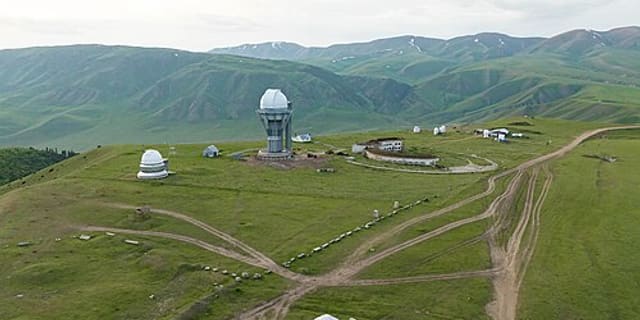
Its key instrument is the Nanshan Radio Telescope, a 25-metre dish that also serves as a VLBI station and supports China's Lunar Exploration Program. A much larger Qitai Radio Telescope, a fully steerable 110-metre dish with roughly 20 times the sensitivity of the 25-metre antenna, is planned. Research at the observatory spans radio and optical astronomy, pulsars, star formation and galaxy evolution, cosmology, high-energy astrophysics, and GPS technology.
Location & getting there
The main facility is near Ürümqi, in Xinjiang, China, part of the wider Asia region.
Visiting the observatory
As a research institution with multiple remote stations, public visiting arrangements are limited; check the National Astronomical Observatories' website for current information before planning a trip.
See your named star from here
Radio and optical instruments like the Nanshan Telescope work by pointing at precise sky coordinates — exactly the kind of coordinates that mark a star you've had named. Name a star of your own, or browse the catalogue to see existing dedications.
Opening hours and public-visit programs vary by season. Check Google Maps for current times before you travel.
Institutional and reference sources used to verify this guide.
Satellite imagery: Esri, Maxar, Earthstar Geographics
Nanshan Station, Xinjiang Observatory
astronomical observatory in Xinjiang, China

 57 km
57 kmXinjiang Astronomical Observatory
astronomical observatory in Xinjiang, China
Xingming Observatory #3, Nanshan
astronomical observatory in Xinjiang, China

 796 km
Assy-Turgen Observatory
observatory in Enbekshikazakh District, Almaty Region, Kazakhstan