
Tomsk State University Observatory
Satellite imagery: Esri, Maxar, Earthstar Geographics
Tomsk State University Observatory has served as an astronomical teaching and research site in Tomsk, Russia, since 1923, blending historic instruments with a long record of public engagement.
About Tomsk State University Observatory
The observatory was founded in 1923 at Tomsk State University, established after the university's Department of Astronomy and Geodesy was set up within the Faculty of Physics and Mathematics.
History
Since the Soviet Union's Sputnik launch in 1957, the observatory has maintained a satellite observation station, regularly tracking Earth satellites as part of what has grown into the wider Tomsk Space Observing System, which also includes Schumann resonance monitoring. More recently, the observatory installed a working replica of Galileo's telescope, offering roughly 60x magnification — about double the magnification of Galileo's original 30x instrument.
Telescopes & research
The observatory's primary instrument is a 13cm refracting telescope with a 2-metre focal length and 200x magnification, capable of showing Mercury, Venus, Mars, Jupiter, Saturn, Uranus, and Neptune, as well as bright star clusters, comets, and asteroids.
Location & getting there
The observatory sits at 137 metres elevation in Tomsk, Russia (about 56.47°N, 84.95°E), on the campus of Tomsk State University in Western Siberia.
Visiting Tomsk State University Observatory
The observatory has hosted public viewing sessions and reopened notably after periods of closure, including a widely reported reopening following a seven-year hiatus. Check the university's current schedule or official channels before visiting.
See your named star from here
With a working refractor able to resolve planets and star clusters, staff or visiting stargazers at Tomsk could point the telescope toward the exact coordinates of a named star. Browse our star-naming packages or the full star catalogue to find yours.
Opening hours and public-visit programs vary by season. Check Google Maps for current times before you travel.
Institutional and reference sources used to verify this guide.
Satellite imagery: Esri, Maxar, Earthstar Geographics

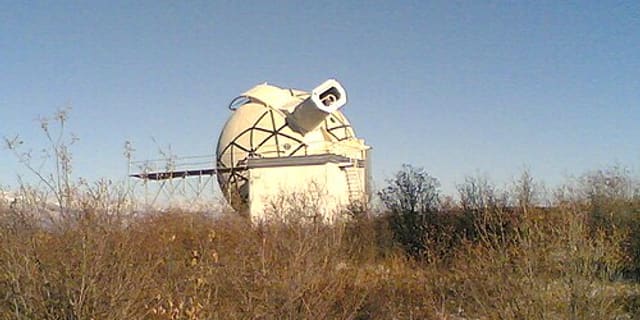 1,170 kmSolar
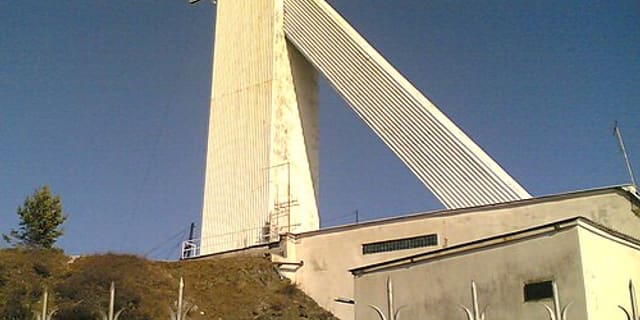 1,390 km
Nanshan Station, Xinjiang Observatory
astronomical observatory in Xinjiang, China