
Sayan Solar Observatory


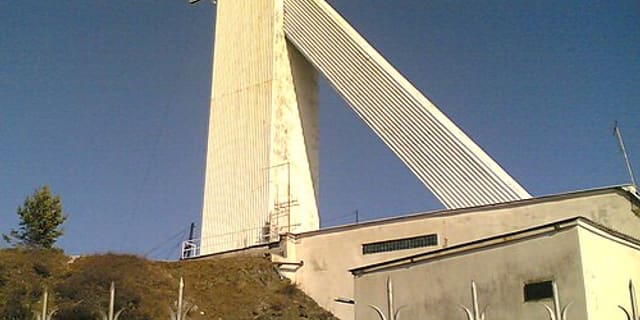
Image: Wikimedia Commons
Sayan Solar Observatory is a high-altitude research station near the settlement of Mondy, in the Tunkinsky District of Buryatia, Russia, dedicated to watching the Sun rather than the night sky.
About Sayan Solar Observatory
Set at around 2,000 metres elevation, roughly 320 kilometres from Irkutsk, the observatory takes advantage of thin, stable mountain air to study solar activity with minimal atmospheric interference.
History
The observatory was established in 1966 by the Institute of Solar-Terrestrial Physics, part of the Siberian Branch of the Russian Academy of Sciences, and has operated as a dedicated solar research site ever since.
Telescopes & research
Its instruments include a horizontal solar telescope fitted with a magnetograph, a coronagraph, and a further solar telescope used for operational forecasting. Researchers here maintain continuous monitoring of the Sun's magnetic fields and coronal activity, alongside studies of cosmic rays and near-Earth space, and the site runs educational programmes linking scientists with students studying solar physics and space weather.
Location & getting there
The observatory sits in the Tunkinsky District of Buryatia, in the mountains around 320 kilometres from Irkutsk, at an elevation of about 2,000 metres, a remote and demanding setting reserved for serious solar research infrastructure.
Visiting Sayan Solar Observatory
As a working research institute, visiting arrangements are best confirmed directly with the Institute of Solar-Terrestrial Physics rather than assumed; its educational programmes suggest visits by students and researchers are welcomed by arrangement.
See your named star from here
Sayan Solar Observatory's instruments are built to study our own star up close, but the same coordinate system used to track sunspots and solar flares also pinpoints any star named through Star Register. On a clear Buryatia night, the sky above this remote site is as good a place as any to look up the right ascension and declination on your certificate. See our star-naming packages or browse the observatory catalogue.
Opening hours and public-visit programs vary by season. Check Google Maps for current times before you travel.
Institutional and reference sources used to verify this guide.
Satellite imagery: Esri, Maxar, Earthstar Geographics

 275 km
 607 km