
Sulphur Mountain Cosmic Ray Station

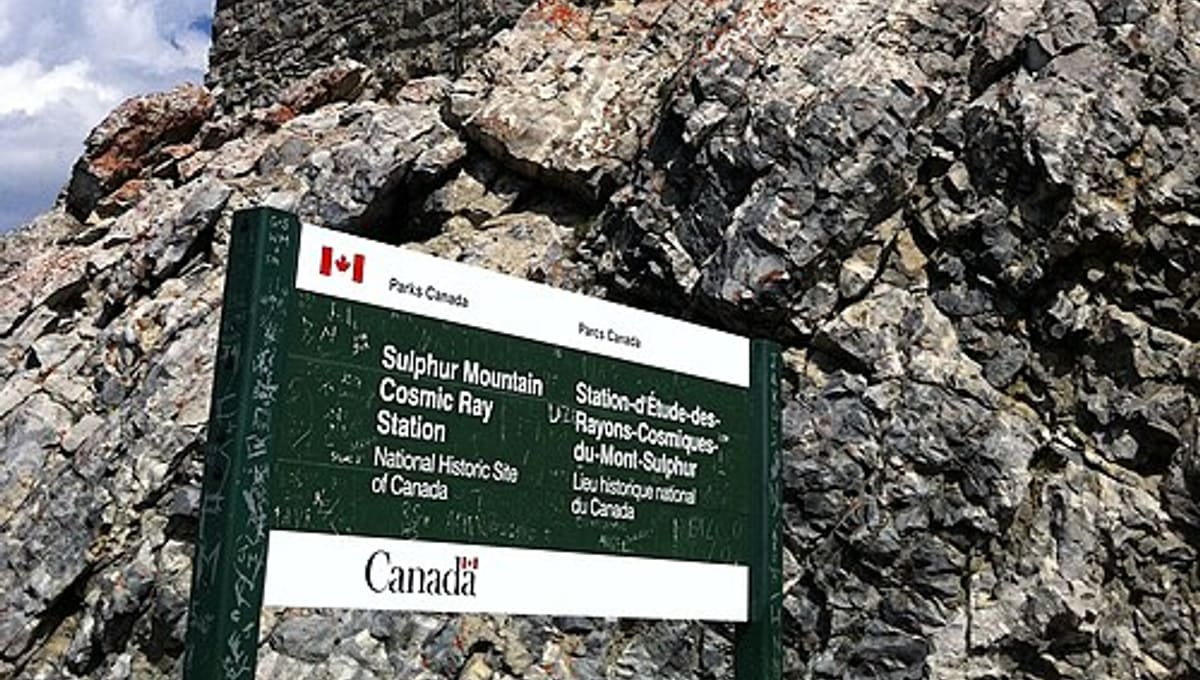
Image: Wikimedia Commons
High on Sulphur Mountain in Banff National Park, Alberta, a small research station once tracked cosmic rays as part of Canada's contribution to a landmark global science effort.
About Sulphur Mountain Cosmic Ray Station
Sulphur Mountain Cosmic Ray Station is a National Historic Site of Canada, commemorating the country's participation in the International Geophysical Year of 1957 to 1958. Records place scientific activity on the mountain as far back as 1902, though the cosmic ray laboratory itself, the site's best-known chapter, was built by the National Research Council over the winter of 1956 to 1957.
History
Canada built nine cosmic ray monitoring sites for the International Geophysical Year, and the Sulphur Mountain station was considered the most important of them thanks to its elevation. The building was deliberately sited so it couldn't be seen from the town of Banff below. It was equipped with a standard IGY neutron monitor and run by Dr. B. G. Wilson with two assistants; the National Research Council operated it until 1960, when the University of Calgary took over, with Dr. Wilson moving to a permanent position there. An upgraded NM64 neutron monitor was installed in 1963, and the original IGY monitor kept running alongside it until 1972. The station closed in 1978, and the building was dismantled in 1981, before the site was designated a National Historic Site in 1982.
Location & getting there
The former station sits atop Sulphur Mountain in Banff National Park, Alberta, Canada, a dramatic setting in the Canadian Rockies now marked with a plaque rather than an active building.
Visiting Sulphur Mountain Cosmic Ray Station
The original laboratory building no longer exists, but the site is accessible as part of Banff National Park, with a plaque marking its former location. Check Parks Canada's information on Sulphur Mountain before planning a visit.
See your named star from here
The scientists who worked here spent years pointing precise instruments at a single, carefully chosen target, much like anyone tracking down the exact coordinates of a star named through Star Register. Name a star, or browse the catalogue of stars already named.
Opening hours and public-visit programs vary by season. Check Google Maps for current times before you travel.
Institutional and reference sources used to verify this guide.
Satellite imagery: Esri, Maxar, Earthstar Geographics

 95 km
95 km
 505 km