
Sternwarte und Planetarium „Sigmund Jähn“ Rodewisch

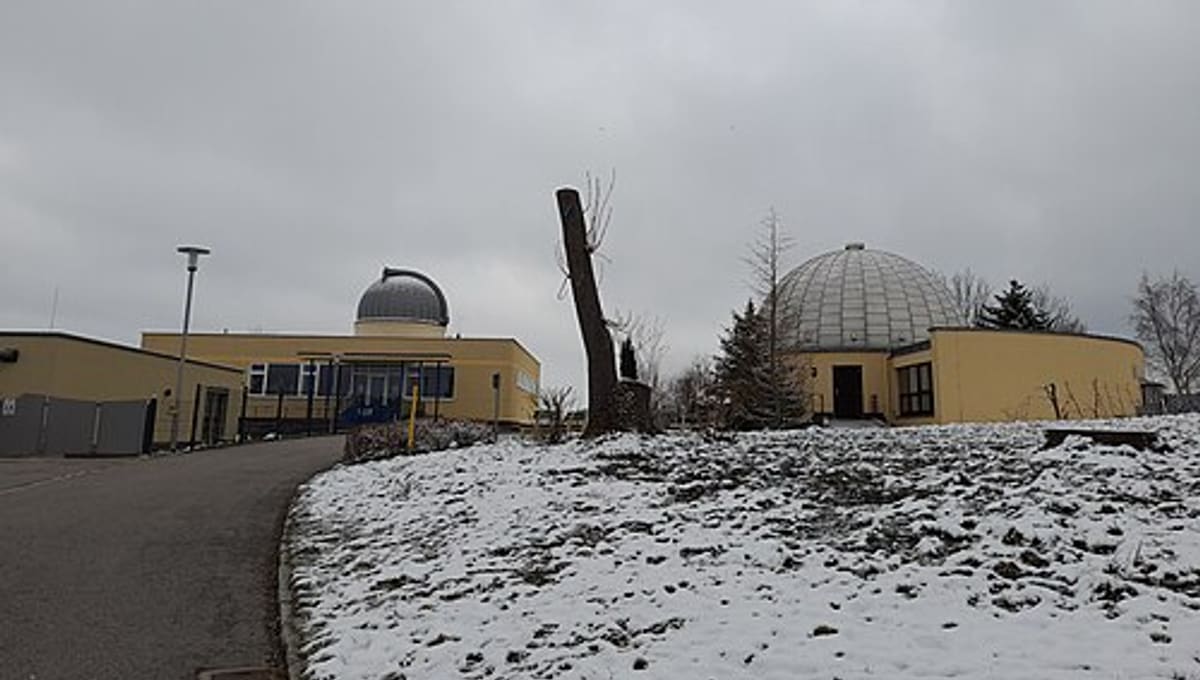
Image: Wikimedia Commons
In the wooded Vogtland hills of eastern Germany, the Sternwarte und Planetarium „Sigmund Jähn“ Rodewisch has been turning local eyes to the sky since the mid-20th century. Named after East Germany's first cosmonaut, it now combines a working amateur observatory with a public planetarium above the town of Rodewisch.
About Sternwarte und Planetarium „Sigmund Jähn“ Rodewisch
The site began life as a school observatory attached to the Pestalozzi Gymnasium in Rodewisch in 1950, before moving to its own independent building in 1967 on the Rützengrüner Höhe overlooking the town. A planetarium was added in 1985 to mark the 25th anniversary of the observatory's Sputnik-era tracking work, and the whole facility was later renamed in honour of cosmonaut Sigmund Jähn.
History
Rodewisch earned an unlikely place in space history in 1957: on 8 October, observer Diethard Ruhnow recorded one of the first sightings anywhere in the world of the Sputnik carrier rocket, and on 13 October the team here logged one of the first tracked orbital trajectories. The observations fed into an international tracking network whose data reached both the Soviet Astronomical Council and NASA. Since 2018 the observatory has been directed by Olaf Graf.
Telescopes & research
Current instruments include a 500 mm mirror telescope with a 3,454 mm focal length, a TEC 160ED refractor (1,280 mm focal length), and a RASA 8-inch astrograph (400 mm focal length), used for public observing evenings and astrophotography.
Location & getting there
The observatory sits on high ground above Rodewisch in the Vogtland region of Saxony, Germany, a landscape of forested hills that keeps skies comparatively dark for the area.
Visiting Sternwarte und Planetarium „Sigmund Jähn“ Rodewisch
The site is not wheelchair accessible, according to local mapping data. For current planetarium show times and observatory open evenings, check the official website before you travel.
See your named star from here
A named star is really just a set of coordinates in the sky, and any telescope capable of tracking the stars - including the instruments on the Rützengrüner Höhe - can be pointed at the right ascension and declination on your star certificate. Browse the full star catalogue to find the star named for you.
Opening hours and public-visit programs vary by season. Check the official website and Google Maps for current times before you travel.
Not wheelchair accessible
Institutional and reference sources used to verify this guide.
Satellite imagery: Esri, Maxar, Earthstar Geographics

 43 km
43 km
 71 km
71 km
 96 kmNon-optical