
Radiosternwarte Kiel

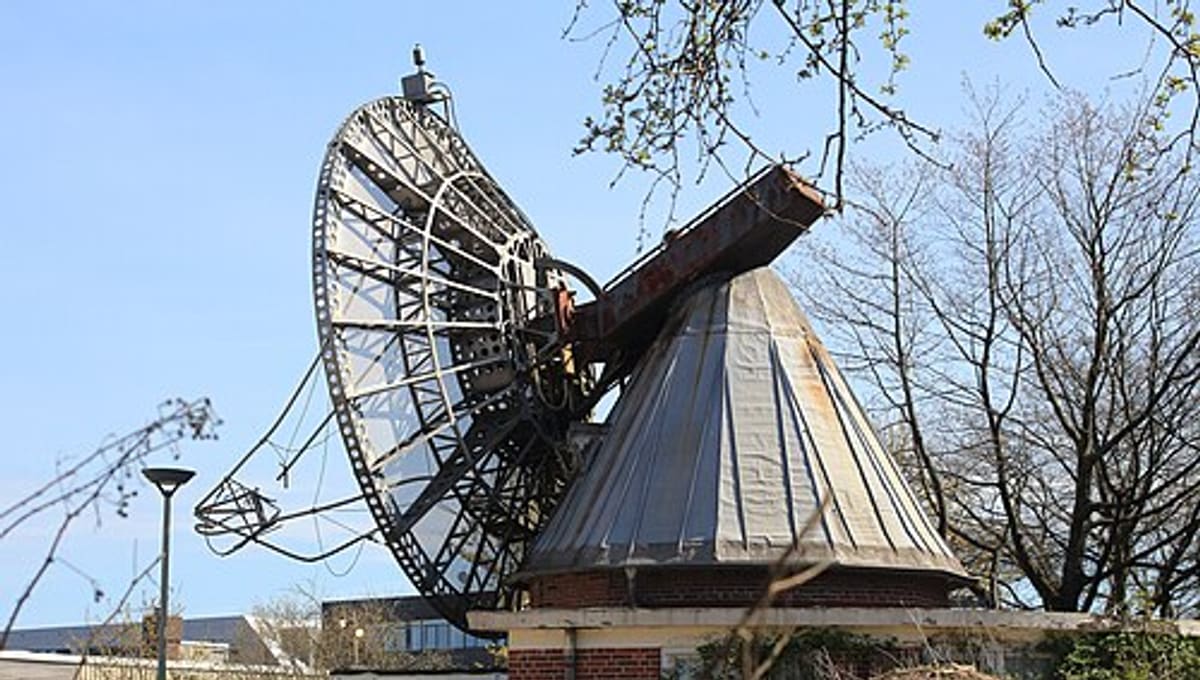
Image: Wikimedia Commons
Radiosternwarte Kiel, or Kiel Radio Observatory, was a facility of the Christian-Albrechts-Universität (CAU) in Kiel, Germany, that operated from roughly 1950 to 1976 as one of the country's earliest homes for radio astronomy.
About Radiosternwarte Kiel
The observatory grew out of planning that began in 1949, led by astronomer Albrecht Unsöld after he encountered captured Würzburg-Riese radar equipment left over from the Second World War. That encounter helped spark the idea of applying radar-derived technology to astronomy.
History
Germany's first radio telescope was approved for construction at the CAU campus in 1956. The observatory ultimately housed two instruments: a steerable array of 21 dipoles operating at 200 MHz, and a parallactically mounted parabolic mirror 7.5 metres in diameter, built toward the end of the 1950s for solar observations. The facility operated for roughly a quarter-century before closing in 1976.
Telescopes & research
The 7.5-metre parabolic mirror telescope still stands today at the end of Max-Eyth-Straße in Kiel, Schleswig-Holstein, though it survives in poor condition with an uncertain future.
Location & getting there
The observatory's surviving telescope is located in Kiel, Schleswig-Holstein, Germany, within the Europe region. Use the map and directions on this page to find the site.
Visiting Radiosternwarte Kiel
As the historic telescope structure remains in poor condition, current public access is not confirmed; check locally before planning a visit.
See your named star from here
Radiosternwarte Kiel's pioneering role in German radio astronomy is a reminder that instruments built to catch invisible wavelengths still point using the same right ascension and declination coordinates that mark a named star's place in the sky. Name a star, or browse the star catalogue.
Opening hours and public-visit programs vary by season. Check Google Maps for current times before you travel.
Institutional and reference sources used to verify this guide.
Satellite imagery: Esri, Maxar, Earthstar Geographics

 15 km
15 km
 67 kmPublic
 96 km
96 km