
Hamburg-Bergedorf Observatory

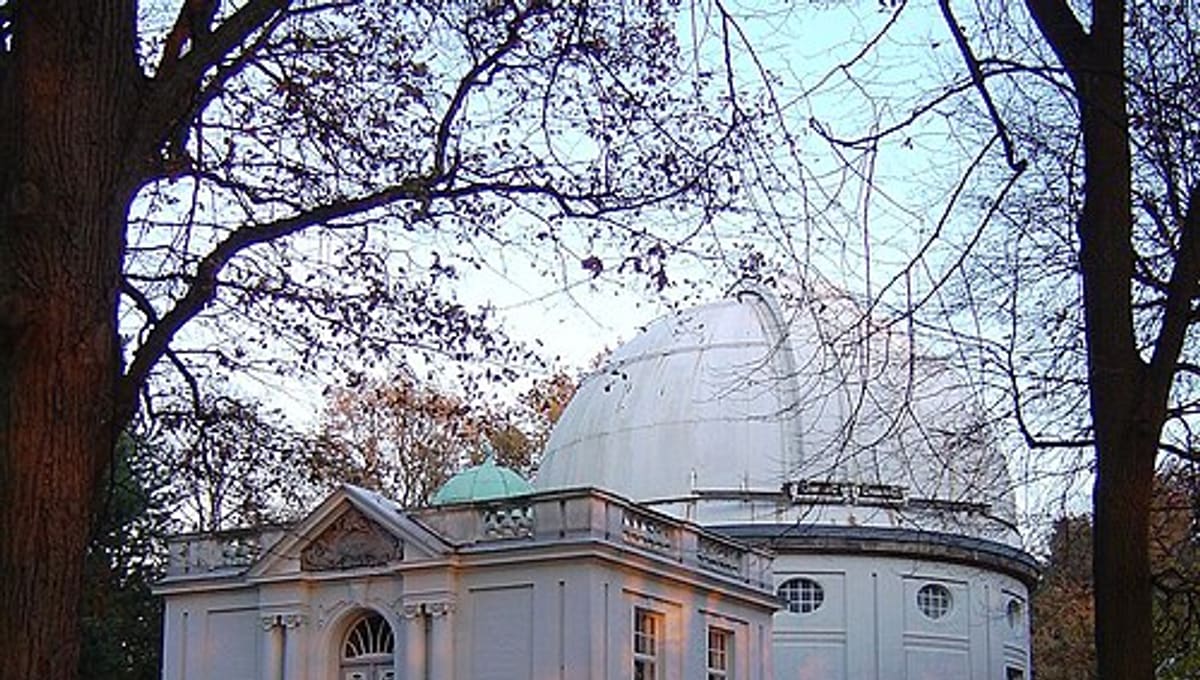
Image: Wikimedia Commons
Hamburg-Bergedorf Observatory is the University of Hamburg's astronomical observatory in the Bergedorf borough of Hamburg, Germany, home to historic telescopes and two centuries of astronomical research.
About Hamburg-Bergedorf Observatory
The observatory was founded in 1825 by the City of Hamburg. Concerned about light pollution and vibrations from the busy port, its directors pushed for a quieter site, and the institution moved to its present location in Bergedorf between 1909 and 1912. Since 1968 it has been owned and operated by the University of Hamburg.
History
Walter Baade worked at the observatory from 1919 to 1931, where in 1920 he discovered 944 Hidalgo, the first known Centaur-class asteroid, and in 1924 the large near-Earth asteroid 1036 Ganymed, roughly 35 kilometres across. An earlier director of the observatory was awarded the Gold Medal of the Royal Astronomical Society in 1854 for an 1852 star catalogue.
Telescopes & research
The observatory's Hamburg 1-metre reflector saw first light in 1911 and was, for a time, one of the largest telescopes in Europe and the fourth largest in the world. It also holds an old-style Great Refractor with a 60-centimetre lens and a nine-metre tube, a smaller 19th-century refractor whose oldest components date to 1867, and the first original Schmidt telescope, a design noted for its wide-field imaging.
Location & getting there
Hamburg-Bergedorf Observatory sits in the Bergedorf borough on the eastern edge of Hamburg, Germany, the same quieter, darker-sky location its directors sought out over a century ago.
Visiting Hamburg-Bergedorf Observatory
As a working university institution, visiting arrangements can vary by season and research schedule, so it's worth checking with the University of Hamburg's astronomy department or the observatory's website before planning a trip.
See your named star from here
Once you've named a star, its exact coordinates can be given to observatory staff so a telescope can be pointed its way. Browse the catalogue to find your star.
Opening hours and public-visit programs vary by season. Check the official website and Google Maps for current times before you travel.
Institutional and reference sources used to verify this guide.
Satellite imagery: Esri, Maxar, Earthstar Geographics

 53 kmPublic
 81 km
81 km