
Radebeul Observatory

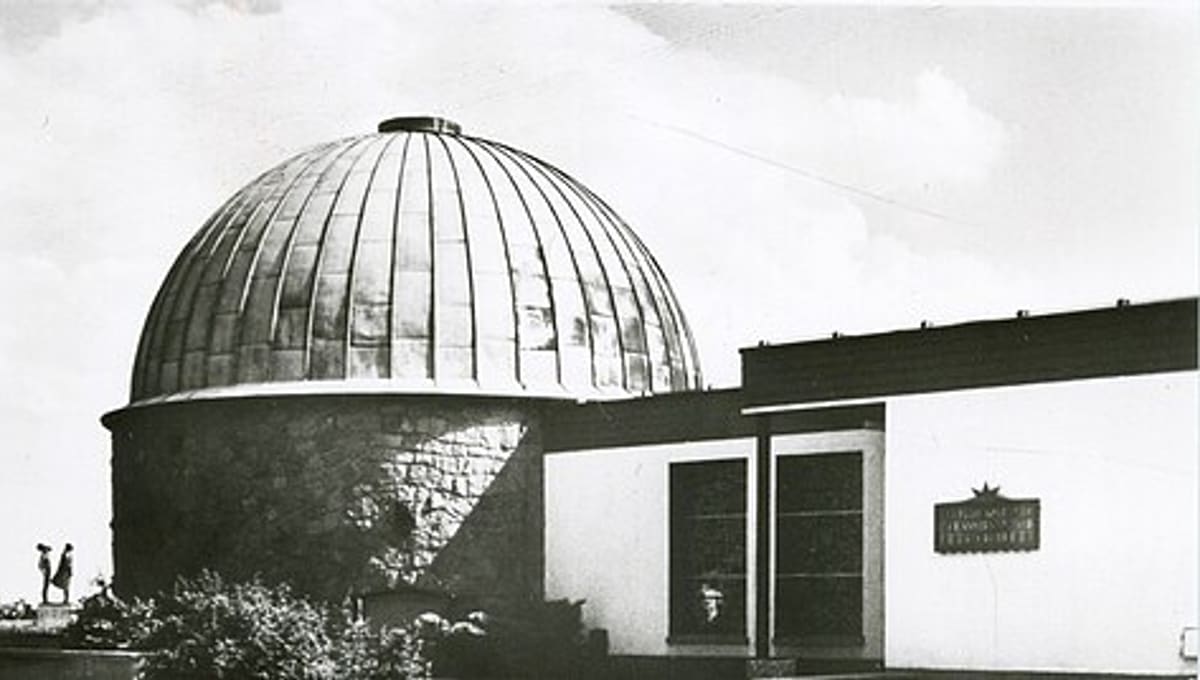
Image: Wikimedia Commons
Radebeul Observatory, officially the Volkssternwarte "Adolph Diesterweg", stands on the border between the Niederlößnitz and Naundorf districts of Radebeul, Germany, roughly 120 metres above the Elbe River.
About Radebeul Observatory
Radebeul Observatory is a public observatory run with the volunteer association Astroclub Radebeul e.V., offering regular public sky observations and astronomical lectures to visitors from the region.
History
Plans for an astronomy department at the site began in 1956, construction of the observatory followed in 1968, and it held its ceremonial opening on 3 October 1969. Since then it has grown into an active centre for both research-minded amateurs and the general public.
Telescopes & research
The observatory's instruments include a Carl Zeiss Coudé refractor with a 16-centimetre aperture and a Maksutov-Newton telescope with a 35-centimetre aperture, alongside a 60-centimetre mobile mirror telescope, the largest mobile telescope in Saxony. Its planetarium, the Radebeul ZKP 4, holds a notable place in astronomy history as the world's first planetarium to use LEDs as its light source. Astroclub Radebeul member Martin Fiedler discovered eleven minor planets between 2005 and 2011 while associated with the observatory.
Location & getting there
The observatory sits at about 120 metres elevation above the Elbe River, in Radebeul, Saxony, within the Europe region. Use the map and directions on this page to plan your route.
Visiting Radebeul Observatory
Radebeul Observatory holds regular public sky observations and astronomical lectures; check its official website for the current schedule and contact details, including its listed phone number, before visiting.
See your named star from here
With a 60-centimetre mobile telescope and decades of public outreach experience, Radebeul Observatory has exactly the kind of equipment that could locate a named star using its right ascension and declination. Name a star, or browse the star catalogue to see stars already named by others.
Opening hours and public-visit programs vary by season. Check the official website and Google Maps for current times before you travel.
Not wheelchair accessible
Institutional and reference sources used to verify this guide.
Satellite imagery: Esri, Maxar, Earthstar Geographics

 23 km
23 km
 32 km
32 km
 48 kmNon-optical
 74 km
74 km