
Lohrmann observatory


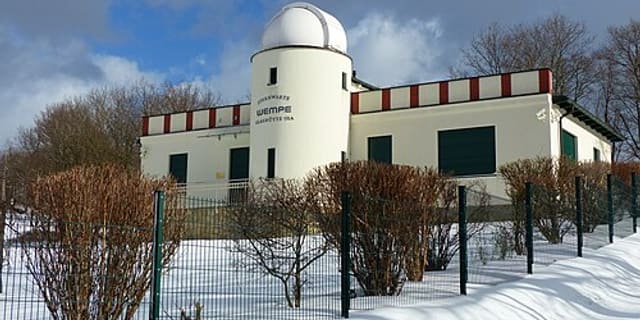
Image: Wikimedia Commons
Lohrmann Observatory was founded in Dresden, Germany in 1913, and still occupies the upper tower of the Beyer Building on the Technische Universität Dresden campus.
About Lohrmann Observatory
The observatory takes its name from Wilhelm Gotthelf Lohrmann, a Dresden astronomer and cartographer whose 19th-century maps of the Moon were among the most detailed of their era. Its home, the Beyer Building, is one of the earliest high-rise buildings in Germany, designed by architect Martin Dülfer with Art Nouveau touches and elements of northern German building styles.
History
Founded in 1913 by Bernhard Pattenhausen, the observatory opened its first telescope in 1915, a refractor commissioned for public demonstration. The site's centrepiece today remains a 30 cm Heyde refracting telescope with a 500 cm focal length, the largest telescope in Saxony, and the observatory also houses a 24-seat planetarium.
Location & getting there
Lohrmann Observatory sits on the southern edge of the TU Dresden campus in Dresden, Germany. Use the map and directions on this page to plan your route into the city.
Visiting Lohrmann Observatory
Check with Technische Universität Dresden or the observatory's own listings for current planetarium shows and public opening times before planning a visit.
See your named star from here
Just as Wilhelm Gotthelf Lohrmann once mapped the Moon in painstaking detail, a Star Register certificate gives you the precise coordinates of a real star bearing your chosen name. From Dresden's historic tower or anywhere with clear skies, that star can be found. Name a star or browse the catalogue.
Opening hours and public-visit programs vary by season. Check the official website and Google Maps for current times before you travel.
Institutional and reference sources used to verify this guide.
Satellite imagery: Esri, Maxar, Earthstar Geographics

 22 km
22 km
 23 kmPlanetarium
 57 km
57 km
 71 kmNon-optical