
Qeqertarsuaq (Godhavn) Magnetic Observatory
Satellite imagery: Esri, Maxar, Earthstar Geographics
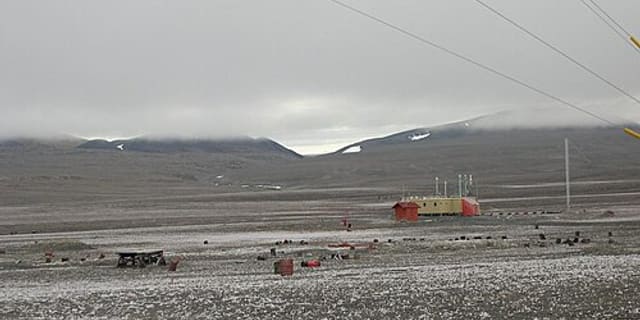
On Disko Island off the west coast of Greenland, the Qeqertarsuaq, or Godhavn, Magnetic Observatory has tracked Earth's magnetic field for nearly a century, part of a chain of stations stretching down Greenland's coast.
About Qeqertarsuaq (Godhavn) Magnetic Observatory
The observatory is a magnetic research station on Disko Island, West Greenland, operated by DTU Space as part of the Greenland magnetometer array. That array includes 19 variometer stations, three of them full geomagnetic observatories, spanning geographic latitudes from 77.47 to 61.16 degrees North along Greenland's west coast chain.
History
It was established in 1926 by the Danish Meteorological Institute. The observatory moved to a new site in 1975 after artificial disturbances from the nearby settlement began affecting the accuracy of its measurements.
Location & getting there
Disko Island lies off the west coast of Greenland, a remote Arctic location chosen and later adjusted specifically to minimise interference with the observatory's sensitive magnetic measurements.
Visiting Qeqertarsuaq (Godhavn) Magnetic Observatory
As a scientific monitoring station within DTU Space's magnetometer network, the observatory is not set up for general tourism; reaching Disko Island itself requires planning given its remote Arctic setting.
See your named star from here
Greenland's Arctic skies, far from city lights, are exceptionally dark on a clear night. The precise right ascension and declination that come with a Star Register certificate work the same way here as anywhere else on Earth to locate a named star. Browse our naming packages or search the catalogue.
Opening hours and public-visit programs vary by season. Check Google Maps for current times before you travel.
Institutional and reference sources used to verify this guide.
Satellite imagery: Esri, Maxar, Earthstar Geographics

 1,483 km
China-Iceland Arctic Science Observatory
joint Chinese-Icelandic polar science facility