
NenuFAR

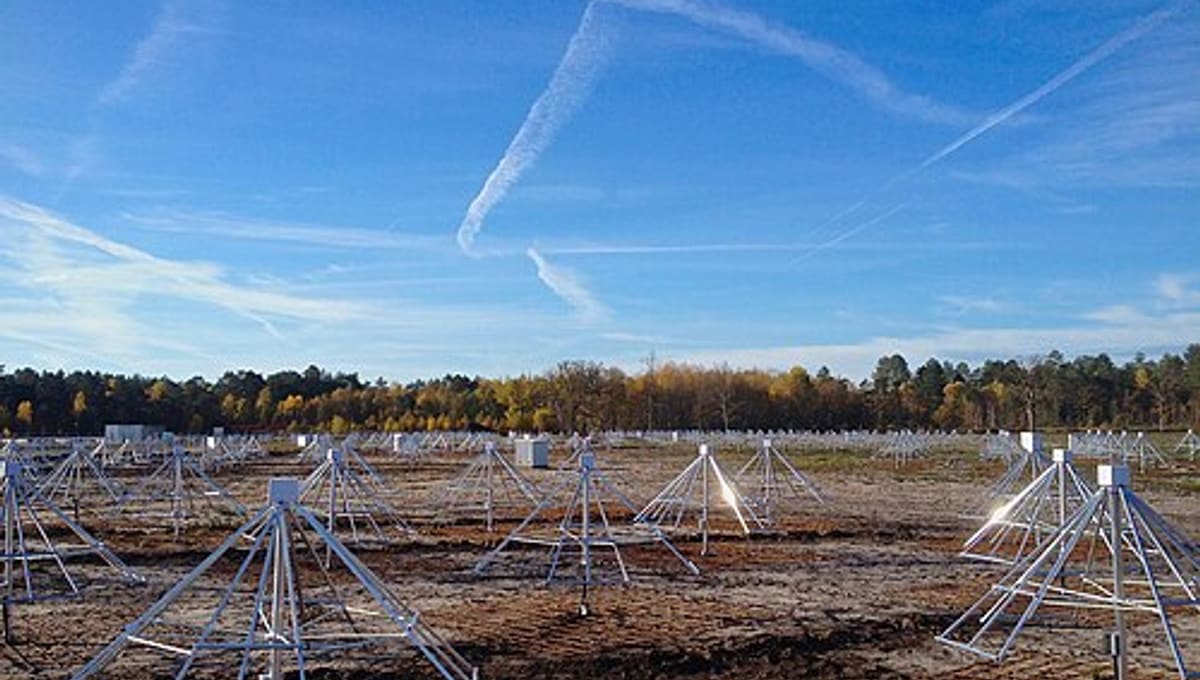
Image: Wikimedia Commons
NenuFAR is a large radio telescope on the Nançay plain in the Sologne region of central France, built to explore one of the last unmapped corners of the radio sky.
About NenuFAR
NenuFAR (New Extension in Nançay Upgrading LOFAR) is operated jointly by the Paris Observatory–PSL, the University of Orléans, and the French national research agency CNRS. Rather than a single dish, it is an array of 1,938 individual antennas, most packed into a dense 400-metre core with additional units spread out to 3 kilometres, all working together as one giant radio ear.
History
NenuFAR grew out of the French station of the international LOFAR network, which was installed at Nançay in 2010. Scientific observations with the new, expanded array began on 1 July 2019, and the instrument was formally inaugurated on 3 October 2019 with support from regional and national funding bodies.
Telescopes & research
NenuFAR is tuned to frequencies between 10 and 85 MHz, a low-frequency window that ground-based radio astronomy had barely touched before it came online. Its huge antenna count lets it process more than 600 gigabits of data every second, giving astronomers a uniquely detailed view of faint, low-frequency radio emission from across the universe.
Location & getting there
The site sits on the flat, rural Sologne plain in central France, part of the wider Nançay radio astronomy station — a location chosen for its quiet radio environment, far from the interference of cities.
Visiting NenuFAR
NenuFAR is a working research instrument rather than a public viewing site. Anyone interested in visiting should check the official website or contact the Nançay station in advance, since access to the antenna field is typically limited to scheduled tours and open days.
See your named star from here
NenuFAR listens to radio waves rather than starlight, but the same coordinates that define a star's place in the sky work for any instrument pointed at it. If you've named a star with Star Register, you can look up its exact right ascension and declination in our star catalogue and find it with an optical telescope at an observatory near you.
Opening hours and public-visit programs vary by season. Check the official website and Google Maps for current times before you travel.
Institutional and reference sources used to verify this guide.
Satellite imagery: Esri, Maxar, Earthstar Geographics

 under 1 kmRadio
 under 1 kmRadio
 147 km