
Mount Abu Observatory

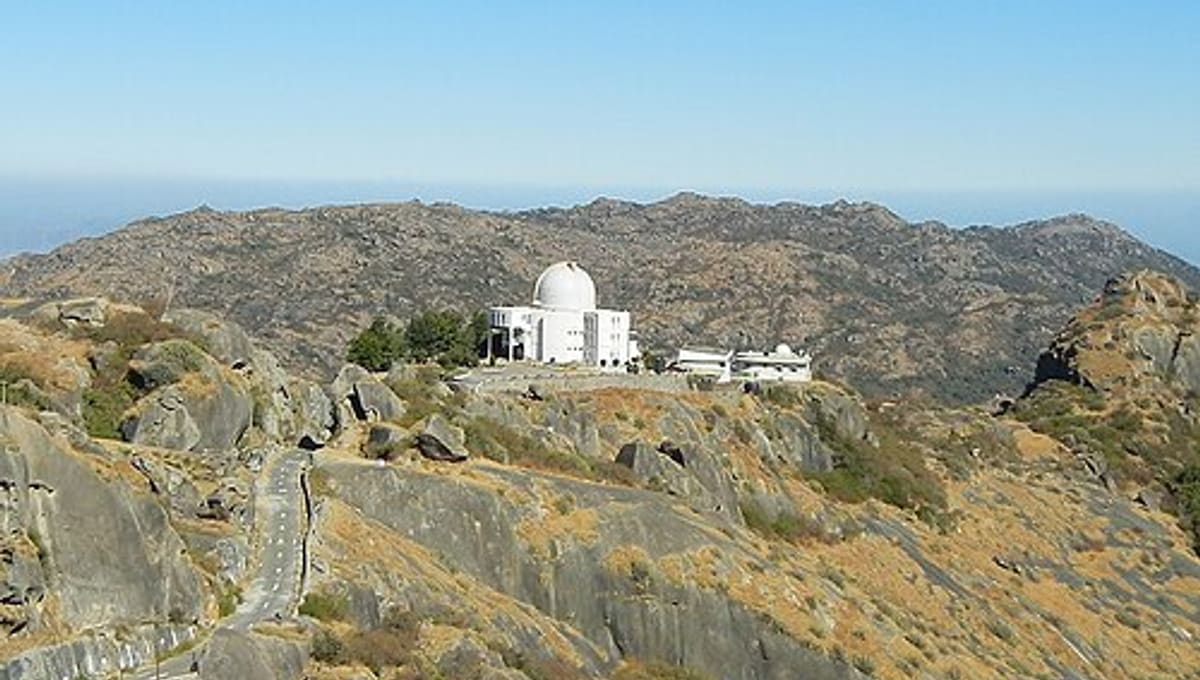
Image: Wikimedia Commons
The Mount Abu InfraRed Observatory, known as MIRO, is India's first major facility built specifically for ground-based infrared astronomy, perched high in the Aravalli Range of Rajasthan.
About Mount Abu Observatory
MIRO sits at an altitude of 1,680 metres near the town of Mount Abu, right next to Guru Shikhar, the highest peak of the Aravalli Range. It is operated by the Physical Research Laboratory (PRL) and was established in 1990, with its 1.2-metre infrared telescope reaching first light in November 1994 and beginning regular operations that December.
Telescopes & research
The observatory's centrepiece is a 1.2-metre infrared telescope, dedicated to ground-based infrared observations of celestial objects. Guru Shikhar's low precipitable water vapour, around 1 to 2 millimetres in winter, combined with roughly 150 cloud-free nights a year, makes it one of India's best sites for this kind of astronomy.
Location & getting there
The observatory is in the state of Rajasthan, in the Asia region, at 1,680 metres elevation adjacent to Guru Shikhar, the highest point in the Aravalli Range near the hill town of Mount Abu.
Visiting Mount Abu Observatory
As a working research facility, MIRO is not a general tourist attraction with fixed public hours. Check the Physical Research Laboratory's website before planning a visit, since access for the public or groups is arranged separately from casual sightseeing.
See your named star from here
Infrared telescopes like MIRO's work from precise sky coordinates, just like the ones printed on your Star Register certificate. Name a star for someone special, then check its position in the catalogue to understand exactly where in the sky it sits.
Opening hours and public-visit programs vary by season. Check the official website and Google Maps for current times before you travel.
Institutional and reference sources used to verify this guide.
Satellite imagery: Esri, Maxar, Earthstar Geographics

 624 km
 686 kmResearch
Inter-University Centre for Astronomy and Astrophysics
Indian institute for Astronomical sciences

 861 km
Devasthal Observatory
observatory center under department of science and technology government of India situated at Uttrakhand India