
MIT Lincoln Laboratory


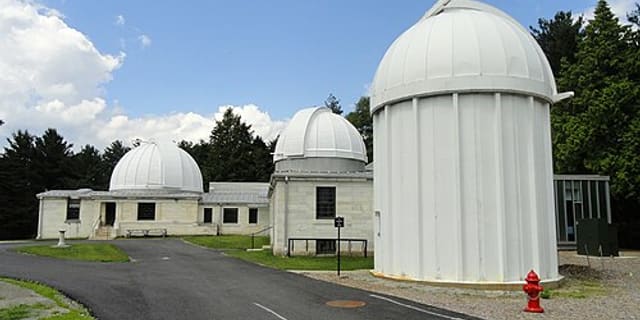
Image: Wikimedia Commons
MIT Lincoln Laboratory is a major US defence research centre at Hanscom Air Force Base in Lexington, Massachusetts, rather than a public astronomical observatory, though its work has touched both radar and asteroid science.
About MIT Lincoln Laboratory
MIT Lincoln Laboratory is a federally funded research and development centre managed by the Massachusetts Institute of Technology on behalf of the US Department of Defense. It sits on a 75-acre site at Hanscom Air Force Base in Lexington, Massachusetts, and today employs around 4,500 people on an annual budget of more than $1 billion, most of it from the Department of Defense.
History
Project Lincoln was chartered on 26 July 1951 to develop an air defence system for the United States, growing out of wartime radar research at MIT. Groundbreaking took place that year and the first buildings were completed in 1952. Its first major project was SAGE (Semi-Automatic Ground Environment), the first large-scale computerised command-and-control network, which later spun off the MITRE Corporation in 1958. Digital Equipment Corporation, founded in 1957 by former Lincoln staff, was another major offshoot.
Research & achievements
Beyond air defence, Lincoln Laboratory's work has ranged widely: its computing research produced Reed-Solomon error-correcting codes and Sketchpad, an early foundation of computer graphics, while its solid-state work contributed to the development of the semiconductor diode laser. For the Federal Aviation Administration it developed the Terminal Doppler Weather Radar and the Traffic Alert and Collision Avoidance System, both now standard in civil aviation. Its Lincoln Near-Earth Asteroid Research (LINEAR) programme discovered more near-Earth asteroids than any other survey, giving the lab a direct link to astronomy despite its defence focus.
Location & getting there
The laboratory is based at Hanscom Air Force Base in Lexington, Massachusetts, in the Boston metropolitan area.
Visiting MIT Lincoln Laboratory
As a defence research facility on an active Air Force base, Lincoln Laboratory is not a public visitor attraction; anyone with a professional or research interest should check the laboratory's official channels before attempting to arrange access.
See your named star from here
Lincoln Laboratory's LINEAR programme spent years scanning the sky for asteroids, a reminder that the same coordinates used to track an asteroid can just as easily locate a star named through Star Register. Check your star's position any time in the star catalogue.
Opening hours and public-visit programs vary by season. Check the official website and Google Maps for current times before you travel.
Institutional and reference sources used to verify this guide.
Satellite imagery: Esri, Maxar, Earthstar Geographics

 18 km
18 kmClay Center Observatory, Brookline
astronomical observatory in Massachusetts, United States

 24 km
24 km
 26 km
26 km