
Millstone Hill Observatory

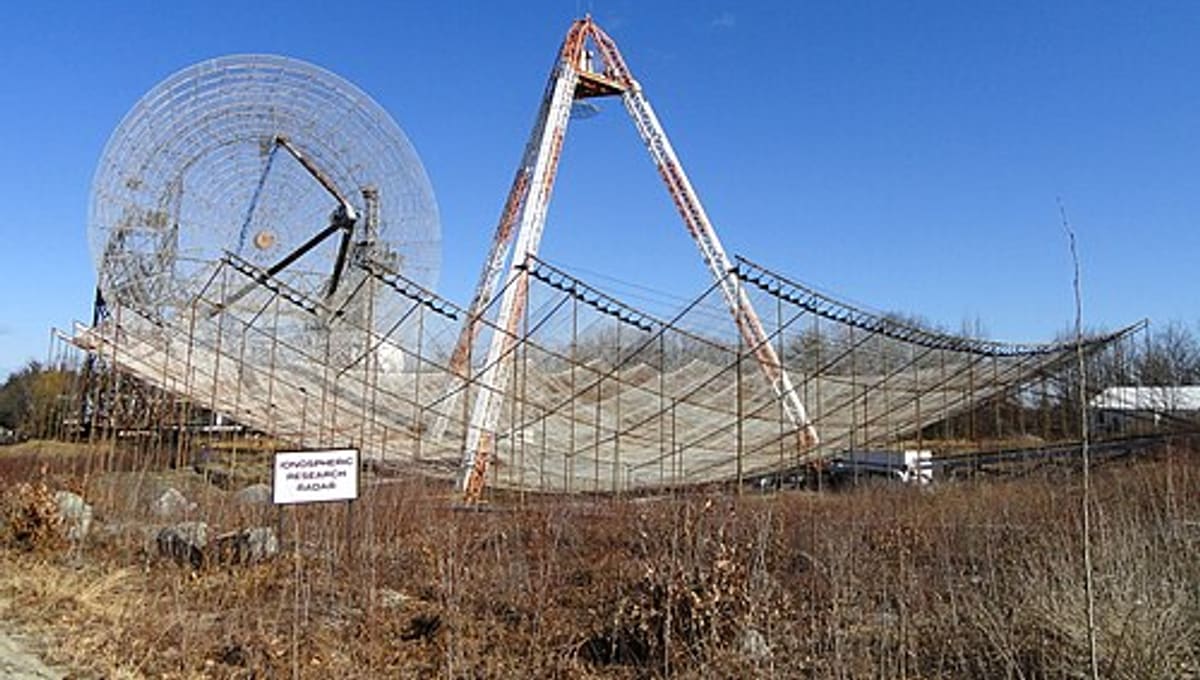
Image: Wikimedia Commons
Millstone Hill Observatory, part of MIT's Haystack Observatory complex in Westford, Massachusetts, is home to one of the world's best-known incoherent scatter radars, used to study the upper atmosphere and space weather.
About Millstone Hill Observatory
Formally the Millstone Hill Geospace Facility, this site is owned and operated by the Massachusetts Institute of Technology as part of the wider Haystack Observatory complex. Its original UHF radar was built in 1958 by MIT Lincoln Laboratory as a prototype for tracking ballistic missiles; since 1974 it has operated as an NSF-supported geospace research facility studying the ionosphere and upper atmosphere.
History
The broader Haystack site began construction in 1960 as the Haystack Microwave Research Facility, built by MIT Lincoln Laboratory for the U.S. Air Force, with its main antenna becoming operational in 1964. In 1970 the facility was transferred to MIT, which formed the Northeast Radio Observatory Corporation (NEROC) with other universities to operate it, a consortium that had grown to nine member institutions by 2012. Lincoln Laboratory still uses part of the site, known there as the Lincoln Space Surveillance Complex.
Telescopes & research
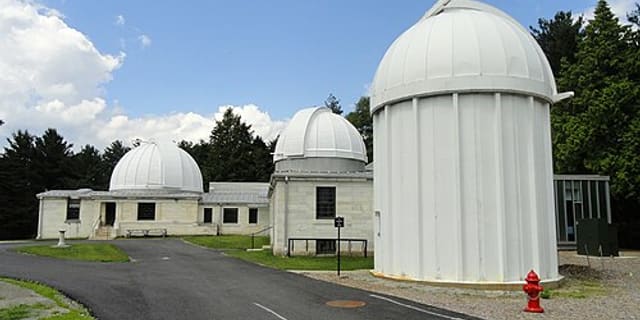
Millstone Hill's instruments include two 2.5 MW UHF transmitters, a fully steerable 46-metre antenna, and a fixed, zenith-pointing 68-metre antenna, together forming one of the two most well-known incoherent scatter radars in the world. The facility also runs GNSS receivers for total electron content mapping and is linked to a network of distributed magnetometers and optical sensors, with data published on the MIT Haystack MADRIGAL database. Long-term monitoring here has tracked a cooling trend in the ionosphere above 200 kilometres altitude. The site is also home to MIT's George R. Wallace Astrophysical Observatory and the clubhouse of the Amateur Telescope Makers of Boston, and a valley on Mercury, Haystack Vallis, is named after the observatory.
Location & getting there
The observatory is located in Westford, Massachusetts, about 45 kilometres (28 miles) northwest of Boston.
See your named star from here
Millstone Hill's radars study the atmosphere and space environment rather than visible starlight, but the same principle of precise coordinates applies: the right ascension and declination on a named star certificate can guide any telescope to the right point in the sky. If you've named a star with Star Register, a visit to the nearby Wallace Astrophysical Observatory or another local telescope could help you find it.
Opening hours and public-visit programs vary by season. Check the official website and Google Maps for current times before you travel.
Institutional and reference sources used to verify this guide.
Satellite imagery: Esri, Maxar, Earthstar Geographics

 14 km
14 km
 26 kmResearch
 39 km
39 kmClay Center Observatory, Brookline
astronomical observatory in Massachusetts, United States