
MiniBooNE
Satellite imagery: Esri, Maxar, Earthstar Geographics
MiniBooNE is a neutrino physics experiment at the Fermi National Accelerator Laboratory (Fermilab) in the United States, built to test whether muon neutrinos oscillate into electron neutrinos over short distances.
About MiniBooNE
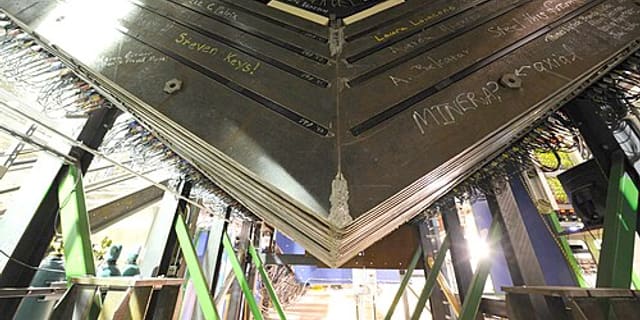
MiniBooNE (the Booster Neutrino Experiment) sends a beam of muon neutrinos into a detector filled with 800 tons of mineral oil and lined with 1,280 photomultiplier tubes, which register the faint flashes of Cherenkov light produced when neutrinos interact. The experiment was designed to check the neutrino-oscillation interpretation of an earlier result from the Liquid Scintillator Neutrino Detector (LSND).
History
The experiment was established in 1997 and began collecting data in 2002, running continuously through at least 2017. In May 2018, MiniBooNE physicists reported a possible signal pointing to the existence of sterile neutrinos, a hypothetical fourth type of neutrino beyond the three known kinds.
Location & getting there
MiniBooNE's detector hall sits on the Fermilab site, a national physics laboratory that also hosts public visitor facilities. It's a working research site rather than a public observatory, so a visit needs to go through Fermilab's own visitor programme.
Visiting MiniBooNE
As an active particle-physics experiment inside a national laboratory, MiniBooNE itself isn't open for casual stargazing visits. Check Fermilab's official visitor information before planning a trip.
See your named star from here
MiniBooNE studies neutrinos rather than starlight, but Fermilab's home turf still sits under the same night sky as everywhere else. If you've named a star with Star Register, you can look up its coordinates in the catalogue and find it from any dark spot nearby.
Opening hours and public-visit programs vary by season. Check the official website and Google Maps for current times before you travel.
Institutional and reference sources used to verify this guide.
Satellite imagery: Esri, Maxar, Earthstar Geographics

 under 1 km
 55 kmResearch
 55 km
55 km
 55 kmResearch
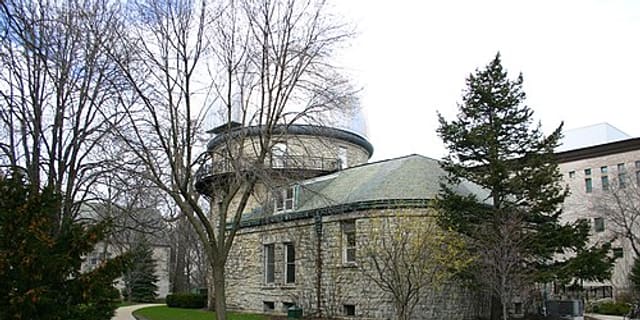
Lindheimer Astrophysical Research Center
former astrophysical observatory in Evanston, Illinois