
MINERνA

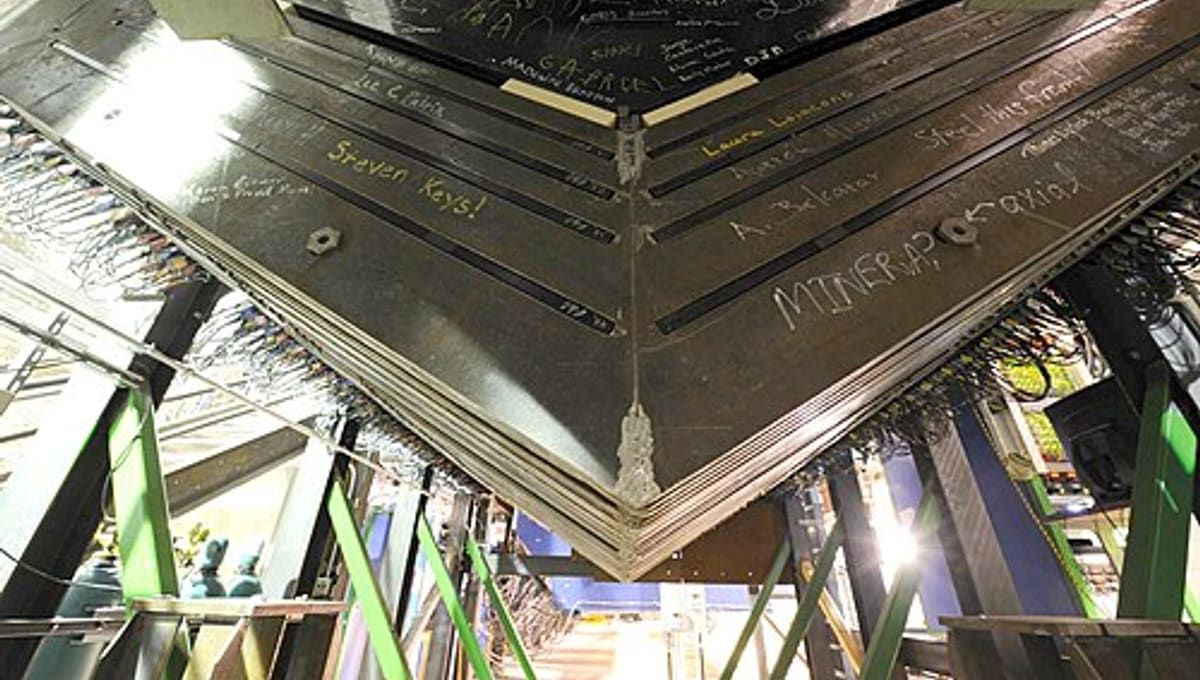
Image: Wikimedia Commons
MINERνA is not a star-gazing observatory but a neutrino physics experiment, buried 100 metres underground at Fermilab in the United States, where it studies particles rather than stars.
About MINERνA
MINERνA - short for Main INjector ExpeRiment ν-A - is a neutrino scattering experiment at Fermilab, sitting in front of the MINOS near detector roughly 100 metres below ground. It uses Fermilab's NuMI neutrino beamline to study low-energy neutrino interactions.
History
The first test module for the detector was built in early 2007, and full construction was completed in January 2010, after which MINERνA began its programme of measurements.
The detector & research
MINERνA uses a fine-grained scintillator target combined with electromagnetic and hadronic calorimetry, with planes of graphite, iron and lead interleaved through the detector to study how the nucleus affects neutrino interactions. Its measurements support neutrino oscillation experiments elsewhere and probe the strong nuclear dynamics of neutrino-nucleus scattering.
Location & getting there
MINERνA sits underground at the Fermi National Accelerator Laboratory (Fermilab) in Illinois, United States, integrated into the NuMI beamline infrastructure rather than standing as a stand-alone building.
Visiting MINERνA
As an underground particle-physics detector rather than a visitor site, MINERνA itself is not open to the public; those interested in Fermilab's public tours and outreach programmes should check the laboratory's own visitor information before travelling.
See your named star from here
MINERνA studies particles from deep underground rather than stars overhead, but the same night sky stretches above Fermilab as everywhere else. If you've named a star with Star Register, you can look up its coordinates any time in the star catalogue and find it from wherever you happen to be.
Opening hours and public-visit programs vary by season. Check Google Maps for current times before you travel.
Institutional and reference sources used to verify this guide.
Satellite imagery: Esri, Maxar, Earthstar Geographics

 55 kmResearch
 55 kmResearch
Lindheimer Astrophysical Research Center
former astrophysical observatory in Evanston, Illinois

 55 km
55 km
 85 km
85 km