
Millimeter Anisotropy eXperiment IMaging Array

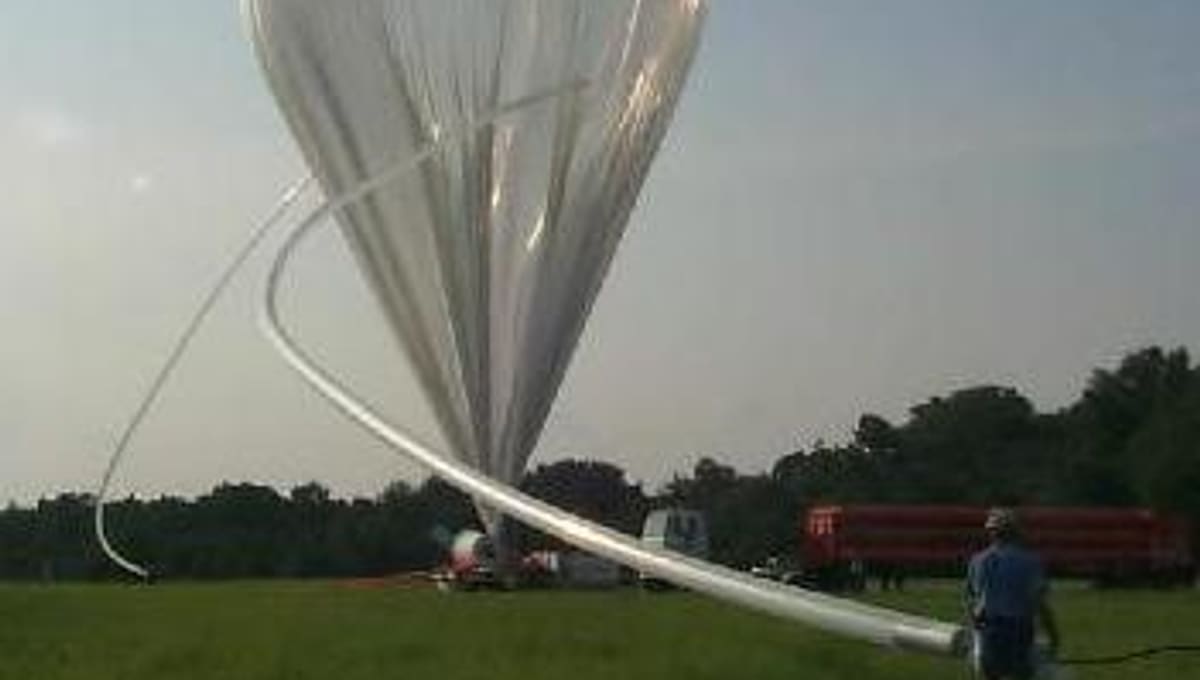
Image: Wikimedia Commons
The Millimeter Anisotropy eXperiment IMaging Array (MAXIMA) was a balloon-borne cosmic microwave background experiment launched from Palestine, Texas, that helped shape how scientists later mapped the infant universe.
About MAXIMA
MAXIMA was funded by the U.S. National Science Foundation, NASA, and the Department of Energy, and operated by an international collaboration led by the University of California. Rather than a fixed building, it was a scientific balloon payload: an array of 16 bolometric detectors operating at 150, 240, and 410 GHz, cooled to 100 millikelvin, that measured fine variations in the cosmic microwave background, the afterglow of the Big Bang. The detector design later served as a prototype for instruments on the Planck Surveyor Satellite.
History
MAXIMA flew twice from the Columbia Scientific Balloon Facility in Palestine, Texas: once in August 1998, and again as MAXIMA-II in June 1999. Each flight climbed to an altitude of about 40,000 metres and stayed aloft for more than eight hours. The first flight mapped roughly 124 square degrees of sky near the constellation Draco; the second, larger flight surveyed about twice that area in the direction of Ursa Major, bringing the combined survey to around 300 square degrees.
Location & getting there
MAXIMA's balloon flights launched from the Columbia Scientific Balloon Facility near Palestine, Texas, in the United States. As a balloon-borne experiment rather than a ground-based facility, there is no permanent site to visit.
See your named star from here
MAXIMA studied the oldest light in the universe rather than individual stars, but the same coordinate systems astronomers use to map the sky, right ascension and declination, are exactly what's printed on a named star certificate. If you've named a star with Star Register, you can use those coordinates with any telescope, anywhere on Earth.
Opening hours and public-visit programs vary by season. Check the official website and Google Maps for current times before you travel.
Institutional and reference sources used to verify this guide.
Satellite imagery: Esri, Maxar, Earthstar Geographics