
MASTER-II observatory
Satellite imagery: Esri, Maxar, Earthstar Geographics
MASTER-Tunka observatory sits in the Tunka valley of Buryatia, Russia, around 50 kilometres from the southern shore of Lake Baikal, watching the sky for sudden bursts of light.
About MASTER-Tunka observatory
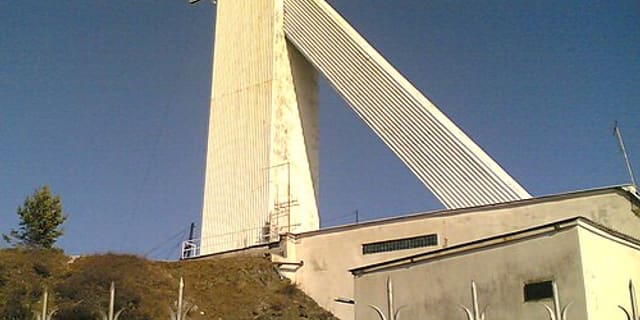
This MASTER-II observatory, known as MASTER-Tunka, is located in the Tunka valley in Buryatia, Russia, close to the southern end of Lake Baikal. It is hosted at the proving ground of the Applied Physics Institute of Irkutsk State University.
History
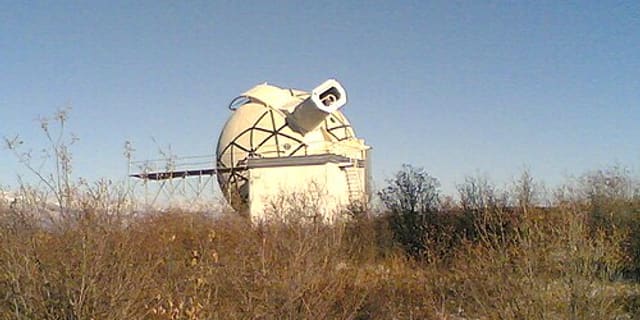
Construction began in 2009 and the station started operating that November, initially using a temporary Flugge telescope. In summer 2010 this was replaced with a Hamilton twin telescope, the instrument that has run the station ever since.
Telescopes & research
MASTER-Tunka is part of the Global MASTER-Net, a network of robotic telescopes coordinated by Lomonosov Moscow State University, and it is used to observe gamma-ray bursts and other transient astronomical events.
Location & getting there
The station sits in the Tunka valley in the Buryatia region of Siberia, roughly 50 kilometres from the southern tip of Lake Baikal, an area valued for its remoteness and dark skies.
Visiting MASTER-Tunka observatory
As a robotic research station run alongside Irkutsk State University's Applied Physics Institute, MASTER-Tunka is not generally open to casual visitors; anyone with a research interest should contact the institute directly.
See your named star from here
Few places feel as far from city lights as the shores near Lake Baikal, making this an evocative spot to imagine a star named through Star Register. Find your star's coordinates any time in the star catalogue.
Opening hours and public-visit programs vary by season. Check Google Maps for current times before you travel.
Institutional and reference sources used to verify this guide.
Satellite imagery: Esri, Maxar, Earthstar Geographics

 126 km
 149 kmSolar