
Kuban State University Astrophysical Observatory
Satellite imagery: Esri, Maxar, Earthstar Geographics
The Kuban State University Astrophysical Observatory is an active research site in southern Russia's Kuban region, dedicated to tracking asteroids, comets, and satellites.
About Kuban State University Astrophysical Observatory
Founded in 1957 as a satellite observation point, the site has grown into South Russia's only optical-electronic astrophysical complex with a mirror diameter exceeding 50 centimetres. It received the international designation C40 from the International Astronomic Center for Minor Planets at Harvard in 2010.
Telescopes & research
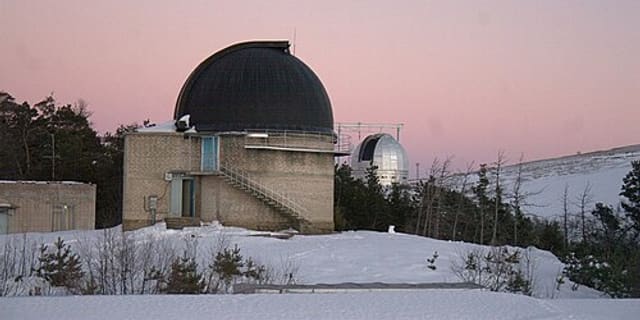
The observatory's main instrument is an automated 508-millimetre reflector, housed alongside four other domes of optical-astrophysical equipment. Its work includes discovering and tracking asteroids and comets, monitoring minor planets, tracking the Spectr-R satellite, and supporting Radioastron navigation research into black holes and galaxy and quasar nuclei. It ranks 86th among thousands of observatories worldwide for asteroid and comet tracking, and also serves as a teaching site for the university's Physics and Engineering faculty.
Location & getting there
The observatory sits in the Kuban region of southern Russia, at an elevation of 71 metres.
Visiting Kuban State University Astrophysical Observatory
As a university research facility, visiting arrangements are best confirmed directly with the site beforehand; see the official page for details.
See your named star from here
An observatory that tracks fast-moving asteroids and comets across the sky knows exactly how coordinates map to real objects overhead. Name your own star with Star Register and browse the sky in our star catalogue.
Opening hours and public-visit programs vary by season. Check Google Maps for current times before you travel.
Institutional and reference sources used to verify this guide.
Satellite imagery: Esri, Maxar, Earthstar Geographics

 244 kmResearch
Astronomical station at North Caucasus of Kazan Federal University
astronomical observatory in Russia

 338 km
 338 km