
KATRIN


Image: Wikimedia Commons
KATRIN, the Karlsruhe Tritium Neutrino Experiment, is a large-scale physics facility at the Karlsruhe Institute of Technology (KIT) in Germany, built to measure the mass of one of the universe's most elusive particles.
About KATRIN
KATRIN examines the beta decay of tritium to measure the mass of the electron antineutrino with sub-eV precision. At its core is a 200-ton spectrometer, and it is a recognised CERN experiment, designated RE14.
History
Commissioning measurements on the spectrometer were completed in 2015, confirming its vacuum, transmission, and background properties. Testing began in October 2016, and the experiment was formally inaugurated on 11 June 2018, followed by a first tritium engineering run that summer. The first science measurements took place on 10 April 2019.
Research
In February 2022, KATRIN announced an upper limit on the antineutrino mass of 0.8 eV/c² at 90% confidence. In April 2025, that result was tightened to 0.45 eV/c² at the same confidence level, among the most precise direct neutrino mass measurements to date.
Location & getting there
KATRIN is housed at the Karlsruhe Institute of Technology in Germany. As a working physics experiment rather than a public viewing site, access is generally arranged through KIT rather than casual visits.
Visiting KATRIN
KATRIN is a research facility, not a public observatory; check the Karlsruhe Institute of Technology's official channels for any tours or open-day events before planning a visit.
Explore more sites in our observatory directory or browse the star catalogue.
Opening hours and public-visit programs vary by season. Check Google Maps for current times before you travel.
Institutional and reference sources used to verify this guide.
Satellite imagery: Esri, Maxar, Earthstar Geographics

 40 kmResearch
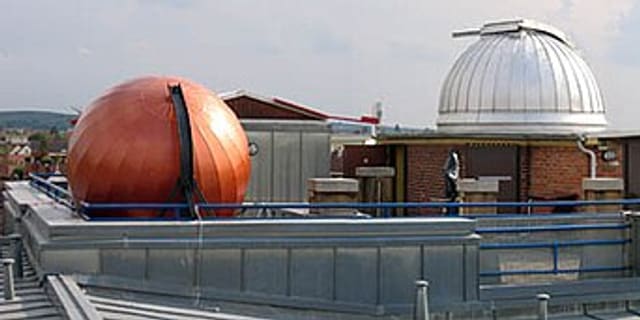 58 kmPublic
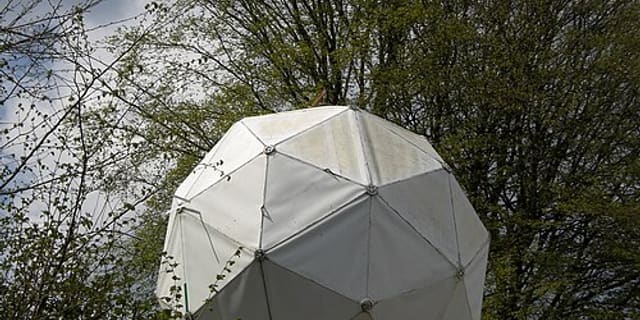 63 kmPublic
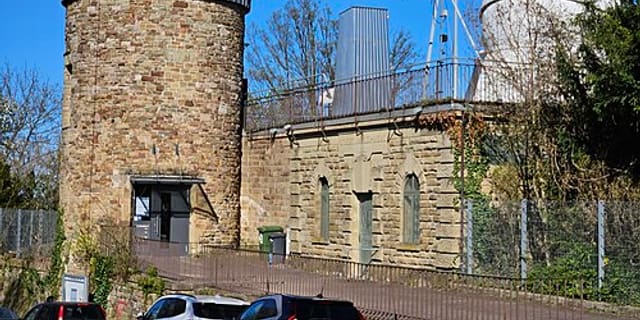 66 kmPublic