
Jodrell Bank Observatory

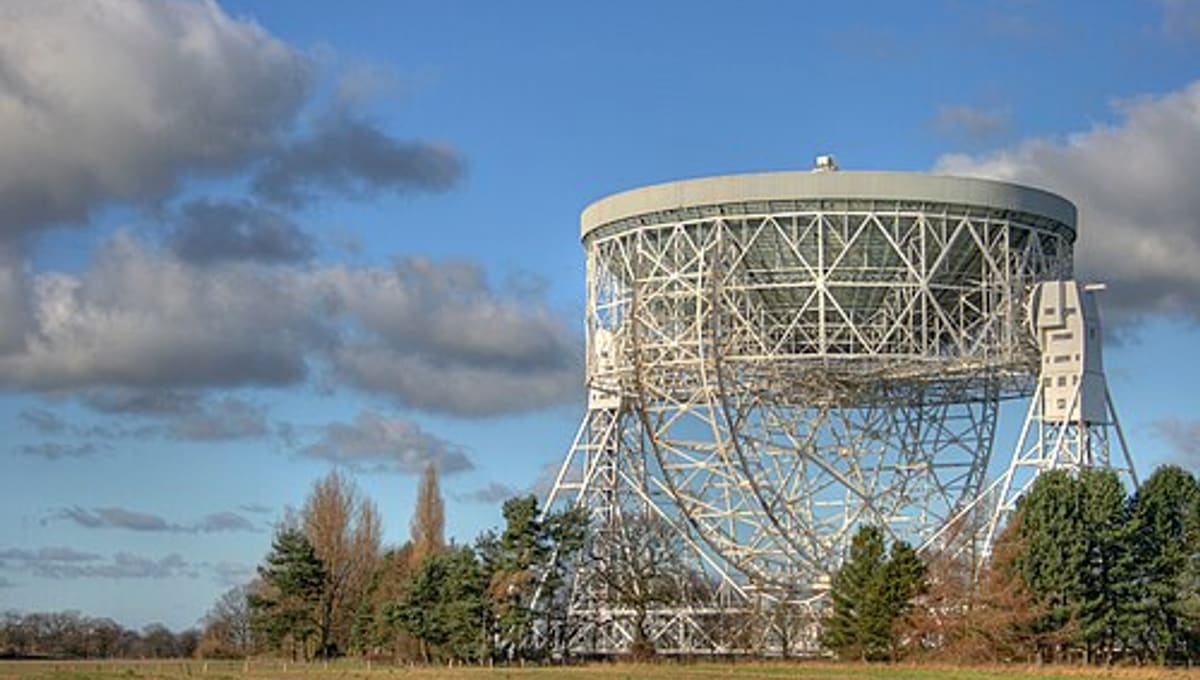
Image: Wikimedia Commons
Jodrell Bank Observatory rises above the Cheshire countryside in England, its giant dish visible for miles around as the home of the University of Manchester's radio astronomy programme.
About Jodrell Bank Observatory
Established in 1945 by radio astronomer Bernard Lovell to investigate cosmic rays after his wartime work on radar, the site is now run by the Jodrell Bank Centre for Astrophysics at the University of Manchester. Over the decades it has played a central role in research into meteoroids, quasars, pulsars, masers, and gravitational lenses, and in tracking early space probes.
Telescopes & research
The Lovell Telescope, the observatory's centrepiece, has a 250-foot (76-metre) diameter dish, making it the third-largest steerable radio telescope in the world. Three further active instruments share the site: the Mark II telescope and radio telescopes of 42 feet (13 metres) and 7 metres in diameter. Jodrell Bank also hosts the global headquarters of the Square Kilometre Array and serves as the base for MERLIN, the Multi-Element Radio Linked Interferometer Network run on behalf of the UK's Science and Technology Facilities Council.
Location & getting there
The observatory sits at 77 metres elevation in Cheshire, England, reached from the A535, with Goostrey railway station a short distance away on the Crewe to Manchester line. In 2019, the site was designated a UNESCO World Heritage Site.
Visiting Jodrell Bank Observatory
The Jodrell Bank Visitor Centre and an arboretum are open to the public in Lower Withington, near Goostrey and Holmes Chapel, giving visitors a close-up view of the Lovell Telescope. Check the official website for current opening hours and ticket prices before travelling.
See your named star from here
While Jodrell Bank's instruments are tuned to radio wavelengths, the same principle applies to any telescope: point it at a set of sky coordinates and you can find what's there, including a named star. Look up any star's exact position in the star catalogue.
Opening hours and public-visit programs vary by season. Check the official website and Google Maps for current times before you travel.
Institutional and reference sources used to verify this guide.
Satellite imagery: Esri, Maxar, Earthstar Geographics

 27 km
27 km
 54 km
54 km
 54 km
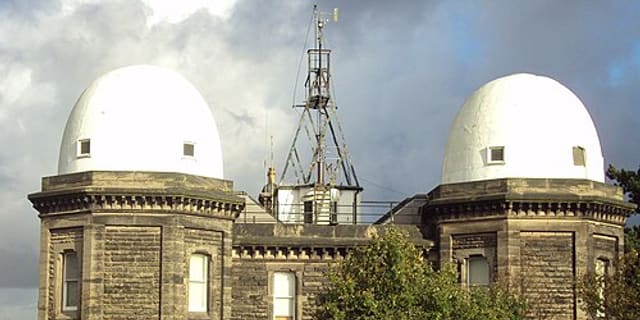
54 kmBidston Observatory
Grade II listed former observatory in Bidston, Wirral, Merseyside, England, UK