
Liverpool observatory (since 1867)
Satellite imagery: Esri, Maxar, Earthstar Geographics
On Bidston Hill, overlooking the Wirral peninsula in England, the Liverpool Observatory has continued its work since 1867, after relocating from the city's Waterloo Dock. Alongside its astronomical role, it became known for firing a daily time signal that shipping on the River Mersey relied on for generations.
About Liverpool Observatory (since 1867)
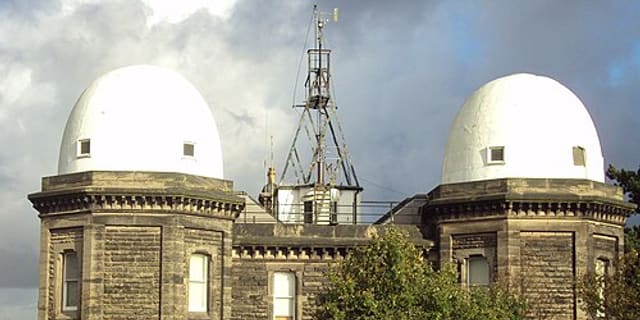
The observatory building on Bidston Hill was designed by architect George Fosbery Lyster and constructed in 1866, sharing the hilltop with the existing Bidston Lighthouse and Signals Station. John Hartnup, who had directed the original Waterloo Dock observatory, continued in the role at Bidston until his retirement in 1885, when his son succeeded him.
History
One of Bidston Observatory's most distinctive features was its One O'Clock Gun, a time signal fired electrically from the observatory every day at 1:00 p.m. to help ships on the Mersey set their clocks. It was first fired on 21 September 1867, using a cannon that had seen service in the Crimean War. In 1919, a Tidal Institute was established alongside the observatory, and on 1 January 1929 the two merged to form the Liverpool Observatory and Tidal Institute.
Location & getting there
Bidston Hill sits on the Wirral peninsula, across the River Mersey from Liverpool, offering wide views over the estuary and surrounding countryside.
Visiting Liverpool Observatory (since 1867)
Bidston Hill and its historic observatory buildings are a well-known local landmark; anyone hoping to visit should check current opening arrangements before travelling, since access to the historic site can vary.
See your named star from here
For decades, this observatory helped Liverpool's ships keep exact time by firing a signal at a precise moment each day. That same spirit of precision applies to every star named through Star Register, each with its own coordinates ready to be found. Browse our naming packages or explore the star catalogue.
Opening hours and public-visit programs vary by season. Check Google Maps for current times before you travel.
Institutional and reference sources used to verify this guide.
Satellite imagery: Esri, Maxar, Earthstar Geographics

 7 km
7 kmBidston Observatory
Grade II listed former observatory in Bidston, Wirral, Merseyside, England, UK

 49 km
49 km
 50 km
50 km
 54 km
54 km