
Hartwell observatory
Satellite imagery: Esri, Maxar, Earthstar Geographics
Hartwell Observatory stands on the grounds of Hartwell House in Buckinghamshire, England, a private astronomical facility built in the early nineteenth century by a country squire with a serious passion for the stars.
About Hartwell Observatory
The observatory was commissioned by John Lee, a Fellow of the Royal Society who inherited Hartwell House and turned part of the estate into a working centre for astronomical observation. The site combined a transit room for precise timing work with a domed equatorial tower, giving Lee and his collaborators instruments for both positional astronomy and general stargazing.
History
Construction began around 1827-1830, not long after Lee took possession of Hartwell House, with the equatorial tower completed by about 1839. The observatory housed the Lee Equatorial, installed in 1829 and often cited as the first clock-driven telescope in England, a mechanical advance that let observers track a star's motion across the sky automatically. Lee's circle included the naval officer and astronomer Admiral William Henry Smyth, and Hartwell House later hosted the founding meeting of the British Meteorological Society in 1850.
Location & getting there
Hartwell Observatory sits in rural Buckinghamshire in southern England, part of the wider Hartwell House estate. The surrounding countryside is typical of the English lowlands rather than a dedicated dark-sky reserve, but it still offers a far better view of the night sky than nearby towns.
Visiting Hartwell Observatory
Hartwell Observatory is a historic private structure rather than a staffed public observatory, so opening hours and access are not standardised. Check the current status of the Hartwell House estate, or contact local astronomical societies, before planning a visit.
See your named star from here
Every star named through Star Register comes with precise coordinates, and a clock-driven telescope of the kind pioneered at Hartwell is exactly the sort of instrument that can be pointed at them. Browse the naming packages or search the star catalogue to find a star to look for under a clear English sky.
Opening hours and public-visit programs vary by season. Check Google Maps for current times before you travel.
Institutional and reference sources used to verify this guide.
Satellite imagery: Esri, Maxar, Earthstar Geographics
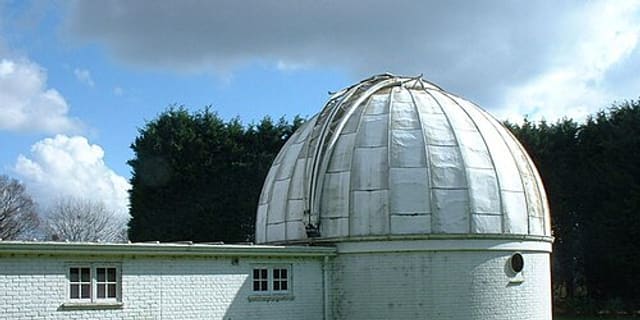
Observatory At South Wing, St Ibbs, 90 Metres To West South West Of House
observatory in St. Ippolyts, North Hertfordshire, England, UK

 65 kmResearch
Cambridge Observatory
astronomical observatory at the University of Cambridge in the East of England

 84 km
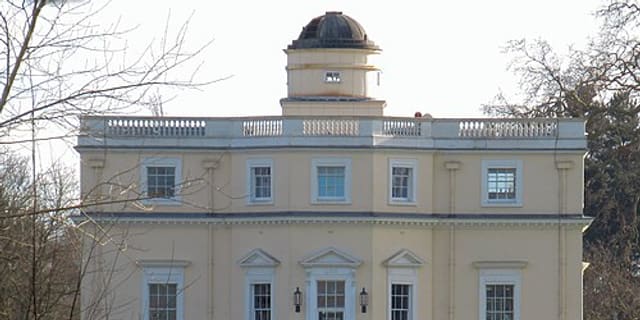
84 kmKew Observatory
Grade I listed architectural structure in London Borough of Richmond upon Thames, United Kingdom