
GALLEX
Satellite imagery: Esri, Maxar, Earthstar Geographics
GALLEX, short for the Gallium Experiment, was an underground neutrino detector operated at the Laboratori Nazionali del Gran Sasso (LNGS) in Abruzzo, Italy, roughly 3,200 metres of water-equivalent depth beneath the mountain.
About GALLEX
GALLEX ran from 1991 to 1997 as a radiochemical detector built to capture solar neutrinos and test theories about how the Sun generates its energy. It was carried out by an international collaboration of French, German, Italian, Israeli, Polish and American scientists, led by the Max-Planck-Institut für Kernphysik in Heidelberg. Its detector tank held 30.3 tons of gallium dissolved in 101 tons of gallium trichloride-hydrochloric acid solution.
History
Alongside the concurrently running SAGE experiment, GALLEX provided the first observations of low-energy solar neutrinos, a milestone in solar and particle physics. After a brief interruption, the programme continued under a new name, GNO (Gallium Neutrino Observatory), from May 1998 to April 2003.
Location & getting there
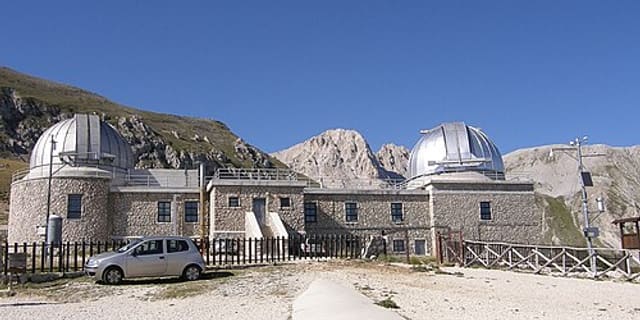
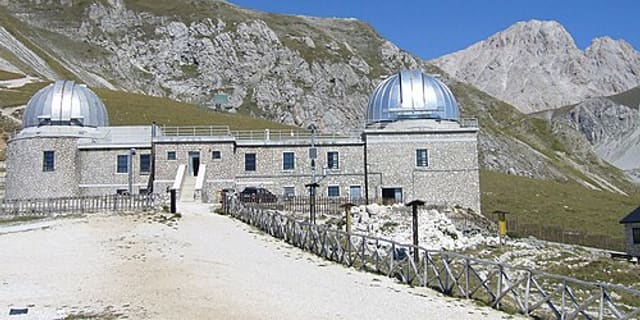
The Gran Sasso underground laboratory sits beneath the Gran Sasso massif in Abruzzo, central Italy, accessible via tunnels connected to the Gran Sasso road tunnel. It remains one of the world's largest underground physics facilities.
Visiting GALLEX
GALLEX itself is no longer operating, but the Gran Sasso National Laboratory continues to host neutrino and particle physics experiments. Check the LNGS official website for information on public outreach and any visitor programmes before planning a trip.
See your named star from here
GALLEX was built to catch neutrinos streaming from the Sun's core, a reminder that even the star nearest to us has always rewarded a closer look. From the surface above Gran Sasso in Abruzzo, a named star's coordinates can be traced with a telescope just as GALLEX once traced particles from below ground. Name a star and find its coordinates in our catalogue.
Opening hours and public-visit programs vary by season. Check Google Maps for current times before you travel.
Institutional and reference sources used to verify this guide.
Satellite imagery: Esri, Maxar, Earthstar Geographics

 4 km
4 km
 4 km
4 km
 31 kmMuseum