
Campo Imperatore Astronomical Observatory


Image: Wikimedia Commons
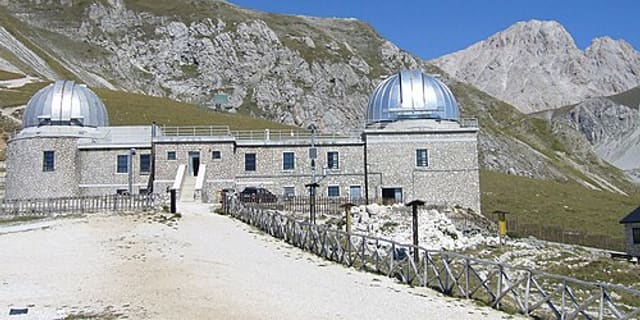
Campo Imperatore Astronomical Observatory sits at 2,129 metres in the Gran Sasso mountains of Abruzzo, Italy, making it the country's highest professional observatory.
About Campo Imperatore Astronomical Observatory
Founded in 1965, the observatory is operated by INAF, Italy's national astrophysics institute. Its altitude places it above much of the atmospheric turbulence that affects lower sites, and a local thermal inversion effect regularly gives it exceptionally dark, clear skies.
History
The observatory's main instrument, the AZT-24 telescope, has an unusual past: it was originally built as a wartime gift intended from Hitler to Mussolini, nicknamed the "Mussolini telescope," before being taken by the USSR after the war. It was returned to Italy following the Cold War and installed at Campo Imperatore in 1997.
Telescopes & research
The AZT-24 is a 1.1-metre Ritchey-Chrétien reflector and is the only Italian ground-based telescope equipped with a dedicated near-infrared instrument, SWIRCAM, covering 1.1 to 2.5 micrometres. Research at the site spans infrared observations of extragalactic supernovae, stellar variability, active galactic nuclei, minor solar system bodies, and even Venus's night airglow.
Location & getting there
The observatory sits at 2,129 metres in the Gran Sasso range of Abruzzo, Italy, within the Europe region — a high-altitude setting reached from the Campo Imperatore plateau.
Visiting Campo Imperatore Astronomical Observatory
For visiting details, the observatory can be contacted on +39 0862 400 008, or check its listing via INAF's Campo Imperatore page before travelling, since access depends on mountain conditions.
See your named star from here
With Italy's highest professional observatory and a telescope built for precise infrared work, Campo Imperatore has exactly the kind of setup that could be aimed at the coordinates of a star you've named. Browse our star-naming packages or the star catalogue to name your own.
Opening hours and public-visit programs vary by season. Check the official website and Google Maps for current times before you travel.
Institutional and reference sources used to verify this guide.
Satellite imagery: Esri, Maxar, Earthstar Geographics

 under 1 km
 27 kmMuseum