
Eureka Magnetic Observatory
Satellite imagery: Esri, Maxar, Earthstar Geographics
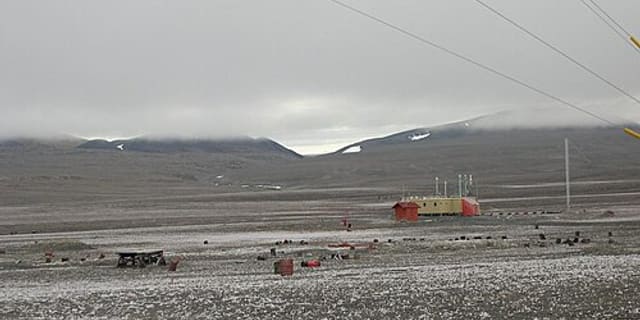
On the remote Fosheim Peninsula of Ellesmere Island, Nunavut, in Canada's High Arctic, the Eureka Magnetic Observatory has tracked the Earth's magnetic field since the earliest days of Canada's Arctic weather network.
About Eureka Magnetic Observatory
The observatory is managed by the Geological Survey of Canada as part of the country's geomagnetic monitoring network. The surrounding station, Eureka, is the second-northernmost permanent weather station in Canada and sits within what scientists call an "auroral hole," close to the north magnetic pole.
History
Eureka was established on April 7, 1947, as part of a joint Arctic weather station network; around 100 tons of supplies were airlifted in and five prefabricated Jamesway huts were erected to house the original crew. Since 2005, the site has also hosted the Polar Environment Atmospheric Research Laboratory (PEARL), run by the Canadian Network for Detection of Atmospheric Change, which studies the aurora and Arctic climate.
Location & getting there
Eureka is one of the most remote inhabited places in Canada, accessible only by air, deep in the High Arctic archipelago far above the tree line.
Visiting Eureka Magnetic Observatory
This is a working scientific research station, not a public attraction, and its extreme remoteness means it isn't set up for casual visitors.
See your named star from here
Even in a place built to study the Earth's magnetic field rather than the stars, you can still look up your named star's coordinates in the Star Register catalogue, or start a naming with one of our packages.
Opening hours and public-visit programs vary by season. Check Google Maps for current times before you travel.
Institutional and reference sources used to verify this guide.
Satellite imagery: Esri, Maxar, Earthstar Geographics

 476 km
China-Iceland Arctic Science Observatory
joint Chinese-Icelandic polar science facility