
Baker Lake Magnetic Observatory
Satellite imagery: Esri, Maxar, Earthstar Geographics
Baker Lake Magnetic Observatory sits on Precambrian granite in Baker Lake, Nunavut, Canada, one of a network of stations that has tracked Earth's magnetic field from the Arctic since the mid-20th century.
About Baker Lake Magnetic Observatory
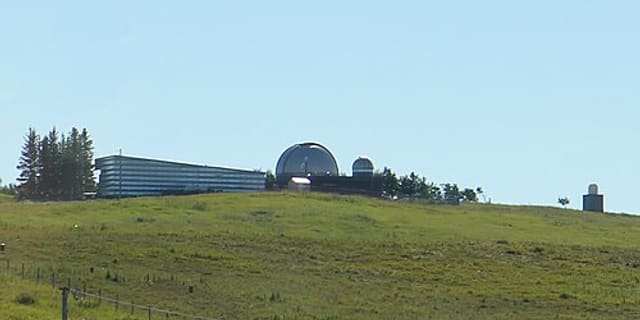
The observatory is operated by the Geological Survey of Canada as a permanent measuring station, monitoring the geomagnetic field with high accuracy over timescales from seconds to decades. It is a geomagnetic station rather than an astronomical one, using variometers and absolute instruments rather than telescopes.
History
The geomagnetic programme at Baker Lake began in 1947, with photographic recording of field variations starting in January 1951 using standard LaCour variometers. Digital recording began in November 1971 with an Earth Physics Branch AMOS Mk I system. The observatory has occupied three buildings over its history: a wooden prefabricated structure from 1948, an aluminum building from 1956 on a nearby cliff, and its current non-magnetic building, built in 1967, which houses the variometers and absolute instruments.
Location & getting there
Baker Lake sits in Nunavut, in Canada's far north, on Precambrian granitic rock of the Canadian Shield. Use the map and directions on this page to plan your route to this remote Arctic community.
Visiting Baker Lake Magnetic Observatory
As a scientific monitoring station rather than a public attraction, the observatory does not appear to offer general visiting programmes. Check with the Geological Survey of Canada or local Baker Lake resources before planning a trip.
See your named star from here
Baker Lake Magnetic Observatory watches the Earth rather than the sky, but the Arctic dark above Nunavut is some of the clearest anywhere for stargazing. Name a star and check the catalogue for its coordinates to look for it from this part of the world.
Opening hours and public-visit programs vary by season. Check Google Maps for current times before you travel.
Institutional and reference sources used to verify this guide.
Satellite imagery: Esri, Maxar, Earthstar Geographics

 1,836 km