
Australia Telescope National Facility
Satellite imagery: Esri, Maxar, Earthstar Geographics
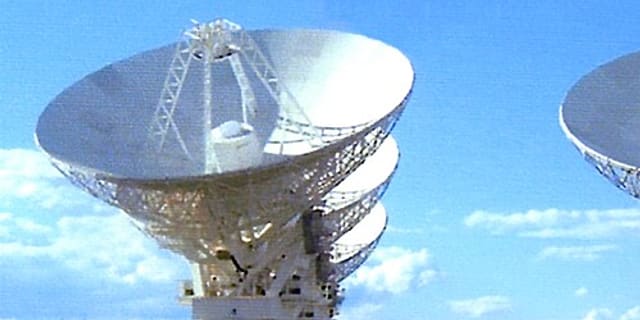
In the flat farmland west of Narrabri, New South Wales, six large radio dishes of the Australia Telescope Compact Array form the visible heart of the Australia Telescope National Facility, CSIRO's national network of radio observatories.
About the Australia Telescope National Facility
The Australia Telescope National Facility (ATNF) is CSIRO's collective name for the radio astronomy observatories it operates across Australia in support of the country's radio astronomy research. Alongside the Compact Array near Narrabri, the ATNF includes the Parkes Observatory and the Mopra Telescope in New South Wales, and the Australian Square Kilometre Array Pathfinder (ASKAP) at the Murchison Radio-astronomy Observatory in Western Australia. The telescopes can also be linked together electronically to work as one very long baseline interferometry array.
Telescopes & research
At Narrabri, the Australia Telescope Compact Array combines several movable radio dishes that can be reconfigured along a track to change the resolution of its observations, letting CSIRO astronomers study everything from star-forming regions in the Milky Way to distant radio galaxies.
Location & getting there
The Compact Array sits around 25 kilometres west of the town of Narrabri, in rural New South Wales, roughly 500 kilometres north-west of Sydney.
Visiting the Australia Telescope National Facility
The Narrabri site has a free, self-guided Visitors Centre open daily from 8am to 5pm, with indoor and outdoor exhibits, an audiovisual presentation about the telescope and radio astronomy, and free space-themed films shown in its small theatre, plus a public electric barbecue area. Coach and school groups are welcome but should book tours well in advance.
See your named star from here
The Compact Array observes radio waves rather than visible light, so it isn't built for star-spotting, but its rural setting near Narrabri sits under some of Australia's darkest skies - a fine place to bring binoculars and the coordinates of a named star from the Star Register catalogue.
Opening hours and public-visit programs vary by season. Check the official website and Google Maps for current times before you travel.
Institutional and reference sources used to verify this guide.
Satellite imagery: Esri, Maxar, Earthstar Geographics

 under 1 km
 116 km