
Siding Spring-LCO A

Image: Wikimedia Commons
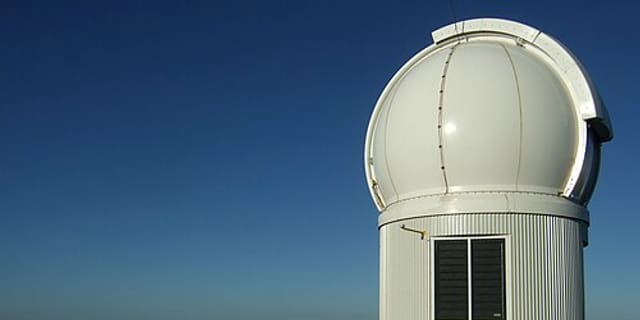
Also sharing the mountaintop at Siding Spring Observatory in New South Wales is a node of the Las Cumbres Observatory (LCO) Global Telescope Network, a set of robotic telescopes that work around the clock as part of a worldwide chain.
About Siding Spring-LCO A
Las Cumbres Observatory is a non-profit organisation, based in Goleta, California, founded in 2005 by technologist Wayne Rosing to build a network of robotic telescopes spanning both hemispheres so that the sky is always being watched somewhere in the world. Its Siding Spring site is one of several LCO nodes worldwide.
History
LCO installed its first telescopes at Siding Spring in 2013, adding to the network's global coverage from the Southern Hemisphere.
Telescopes & research
The Siding Spring node hosts a 2-metre Ritchey-Chrétien telescope, two 0.4-metre telescopes housed together in a clam-style dome, and two 1-metre telescopes each in their own dome. All operate robotically as part of LCO's connected global network rather than through individual, on-site observers.
Location & getting there
The site sits within the Siding Spring Observatory complex in New South Wales, Australia, sharing the mountain's dark, dry skies with the observatory's many other telescopes.
Visiting Siding Spring-LCO A
Because LCO's telescopes run robotically with no on-site observers, this isn't a conventional visitor attraction; anyone interested in seeing it should check with Siding Spring Observatory's own visitor facilities or LCO directly.
See your named star from here
A robotic network built to watch the whole sky, every night, is a fitting match for a star named through star-register.eu: every certificate comes with real coordinates a telescope like these could be aimed at. Take a look at our star catalogue or our naming packages to name a star of your own.
Opening hours and public-visit programs vary by season. Check Google Maps for current times before you travel.
Institutional and reference sources used to verify this guide.
Satellite imagery: Esri, Maxar, Earthstar Geographics

 under 1 kmSpace
Digitized Sky Survey
digitization of several astronomical surveys by the Space Telescope Science Institute

 under 1 km
 under 1 km