
SkyMapper

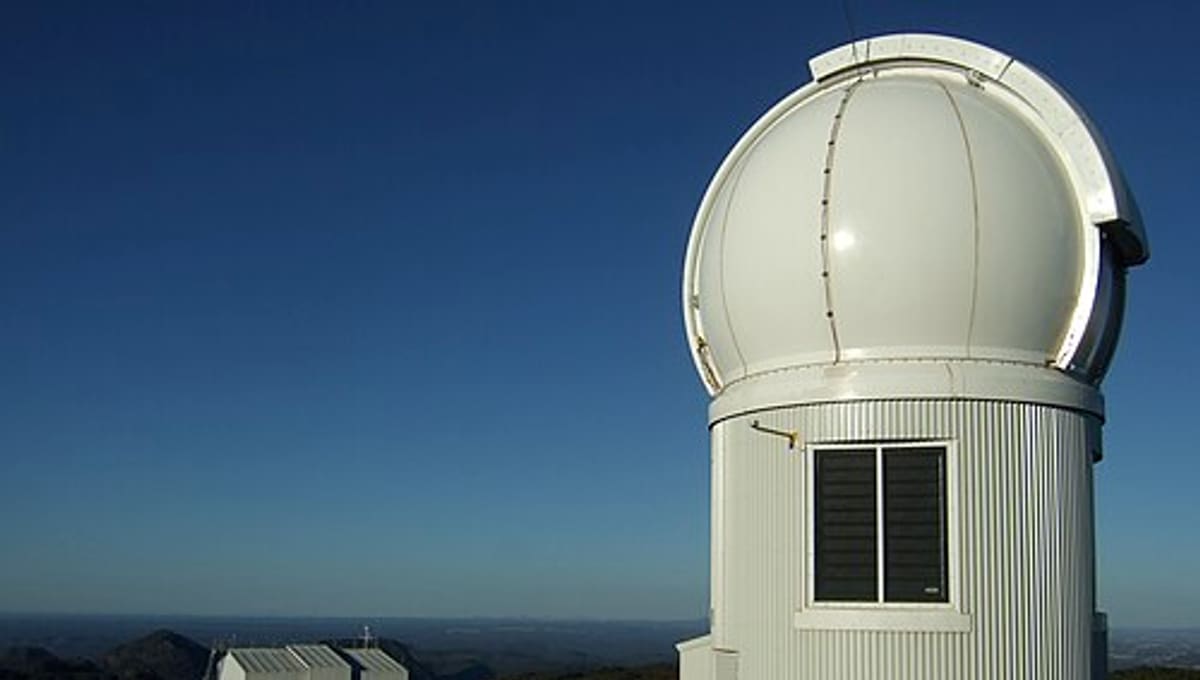
Image: Wikimedia Commons
At Siding Spring Observatory in northern New South Wales, Australia, a fully automated telescope has spent well over a decade methodically photographing the entire southern sky. SkyMapper is the Australian National University's answer to the great sky surveys of the north.
About SkyMapper
SkyMapper is a 1.35 metre wide-angle optical telescope with a compact modified Cassegrain design and a large 0.69 metre secondary mirror, giving it an unusually wide field of view. Its single dedicated instrument, a 268-million pixel camera, can photograph 5.7 square degrees of sky in one shot across six filters spanning ultraviolet to near infrared light. It is operated by the Research School of Astronomy and Astrophysics at the Australian National University (ANU).
History
SkyMapper was founded in 2008 and inaugurated in 2009, built as a successor to the Great Melbourne Telescope at Mount Stromlo after that historic instrument was destroyed in the 2003 Canberra bushfires. The project is funded by the Australian Research Council. Its primary mission is the Southern Sky Survey, imaging the entire southern sky multiple times over - the southern-hemisphere counterpart to North America's Sloan Digital Sky Survey - capturing precise stellar measurements and coverage of the Milky Way's galactic plane.
Location & getting there
SkyMapper is sited at Siding Spring Observatory at 1,163 metres elevation in northern New South Wales, Australia, one of the country's premier dark-sky astronomical sites.
Visiting SkyMapper
Siding Spring Observatory hosts a visitor center with public information about its telescopes; check skymapper.anu.edu.au or the observatory's visitor information before planning a trip, since SkyMapper itself operates fully automated without on-site staff.
See your named star from here
A telescope built to map the entire southern sky is a fitting way to think about your own place among the stars. Name a star to get its precise coordinates, or browse the catalogue of stars already named by others.
Opening hours and public-visit programs vary by season. Check the official website and Google Maps for current times before you travel.
Institutional and reference sources used to verify this guide.
Satellite imagery: Esri, Maxar, Earthstar Geographics

 under 1 km
 under 1 kmSpace
Digitized Sky Survey
digitization of several astronomical surveys by the Space Telescope Science Institute

 under 1 km