
Warrumbungle Observatory
Satellite imagery: Esri, Maxar, Earthstar Geographics
Warrumbungle Observatory sits on Mount Woorat within Warrumbungle National Park near Coonabarabran, New South Wales, and is better known to astronomers worldwide as Siding Spring Observatory, home to Australia's largest optical telescopes.
About Warrumbungle Observatory
The site is owned by the Australian National University (ANU) and hosts more than 60 telescopes and instruments, together worth over A$100 million, run by a mix of Australian and international institutions. It sits at an elevation of 1,165 metres on Mount Woorat, chosen for its dark, high-altitude skies away from city lights.
History
The observatory's flagship instrument, the 3.9-metre Anglo-Australian Telescope, has been operating since 1974. It was joined in 1984 by the 2.3-metre Advanced Technology Telescope, and the site is also home to the 1.24-metre UK Schmidt Telescope and the 1.3-metre SkyMapper Telescope, which began operations in 2009.
Telescopes & research
Beyond its headline instruments, the observatory hosts the 2-metre Faulkes Telescope, HAT-South, the Korean Microlensing Telescope Network (KMTNet) and the robotic PROMPT telescopes, making it one of the most instrument-dense observing sites in the Southern Hemisphere.
Location & getting there
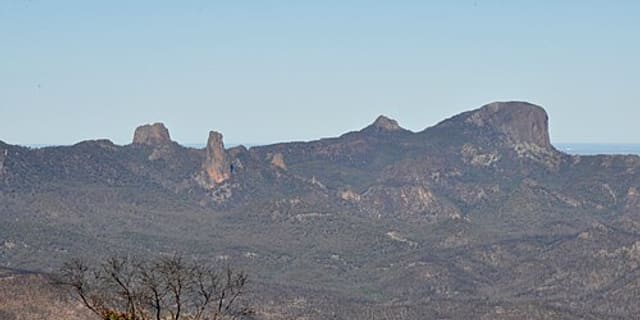
Warrumbungle Observatory is set within the Warrumbungle National Park landscape near Coonabarabran in inland New South Wales, Australia, a region designated a dark sky park across its 23,312 hectares specifically to protect the observatory's night skies.
Visiting Warrumbungle Observatory
The site has a visitors' gallery and exhibition area open to the public, along with a café and souvenir shop. Guided tours are offered during New South Wales school holidays; check the observatory's own channels for current opening times before travelling.
See your named star from here
Few sites anywhere have the telescope density of Warrumbungle Observatory, and its dark sky park status means conditions here are about as good as observing gets. Explore our naming packages or browse the star catalogue to find a star worth seeking out under these skies.
Opening hours and public-visit programs vary by season. Check Google Maps for current times before you travel.
Institutional and reference sources used to verify this guide.
Satellite imagery: Esri, Maxar, Earthstar Geographics

 12 km
12 km
 12 kmSpace
Digitized Sky Survey
digitization of several astronomical surveys by the Space Telescope Science Institute

 12 km
12 km