
Astronomical Observatory of Capodimonte

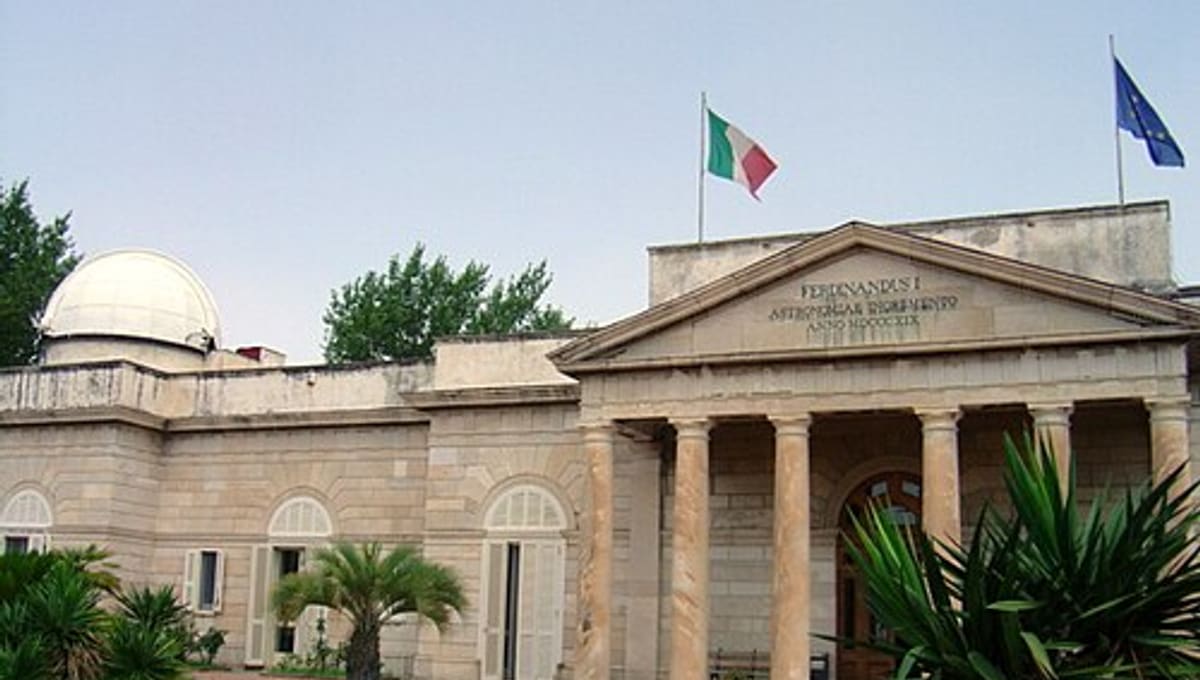
Image: Wikimedia Commons
On the hill of Capodimonte in Naples, Italy, stands one of Europe's most historic working observatories, a neoclassical monument to 19th-century astronomy that remains an active research centre today.
About Astronomical Observatory of Capodimonte
The Astronomical Observatory of Capodimonte (Osservatorio Astronomico di Capodimonte) is the Neapolitan department of Italy's National Institute for Astrophysics (INAF). It is the oldest scientific institution in Naples and today combines frontline research with a strong public-outreach mission, including a planetarium, a museum of historic instruments, and an astronomical library.
History
Astronomy in Naples had already been organised under Joseph Bonaparte in 1807, but the observatory as it stands today began with a decree signed by King Joachim Murat on 8 March 1812, establishing a new building on the Miradois hill near the royal palace of Capodimonte. Astronomer Federigo Zuccari and architect Stefano Gasse designed the neoclassical structure, the first of its kind in Naples, with its foundation stone laid on 4 November 1812. The building was equipped with advanced instruments, including a Fraunhofer equatorial telescope with a 17.5 cm objective lens, then the largest ever made. Construction was completed in 1819 under the supervision of astronomer Giuseppe Piazzi, and the first observation from its dome came on 17 December 1819, when Carlo Brioschi observed the star Alpha Cassiopeiae.
Telescopes & research
Today the observatory is engaged in major international projects, including the Solar Orbiter and ExoMars missions, gravitational-wave research, and instrument development for the next-generation Extremely Large Telescope (E-ELT). For visitors, it operates a 40 cm telescope and the Giuri Gagarin Planetarium, and it houses the MuSA Museum of Astronomical Instruments alongside a historic library of rare astronomy books.
Location & getting there
The observatory sits at around 150 metres elevation on Capodimonte hill, within grounds shared with the well-known Capodimonte park and museum complex in Naples, Italy.
Visiting Astronomical Observatory of Capodimonte
The observatory runs guided visits and school programmes to its telescope and planetarium, though places for these tours can fill up well in advance. Check the official website or call +39 081 5575 111 before planning a trip, since availability changes throughout the year.
See your named star from here
A named star's coordinates, its right ascension and declination, are exactly what an observatory's telescope operators use to find any object in the sky. If you've reserved a star through our packages, staff here could in theory locate it; browse the catalogue to see what's available.
Name a star of your own
Whether or not you can visit Astronomical Observatory of Capodimonte, you can dedicate a real, visible star through Star-Register. Name a star to receive its exact coordinates, or browse the star catalogue to look one up.
Opening hours and public-visit programs vary by season. Check the official website and Google Maps for current times before you travel.
Institutional and reference sources used to verify this guide.
Satellite imagery: Esri, Maxar, Earthstar Geographics

 102 km