
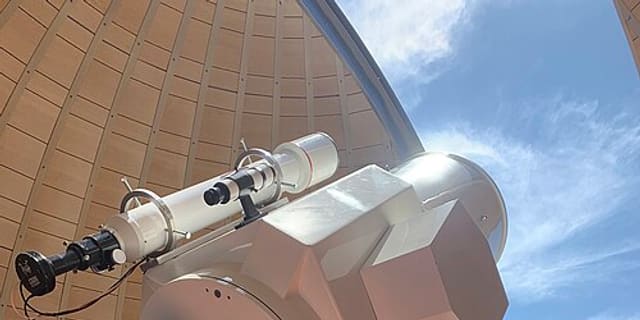
ISON-Castelgrande Observatory


Image: Wikimedia Commons
The ISON-Castelgrande Observatory sits high in the hills of Basilicata, southern Italy, where clear skies support round-the-clock watch for asteroids, comets and space debris. Since 2017 it has fed data into one of the world's largest asteroid- and satellite-tracking networks.
About ISON-Castelgrande Observatory
ISON-Castelgrande Observatory is a joint Italian–Russian research station operated under the CastelGAUSS Project, a collaboration between the Italian aerospace company GAUSS Srl and the Keldysh Institute of Applied Mathematics (KIAM) of the Russian Academy of Sciences. It forms part of the International Scientific Optical Network (ISON), a global chain of stations dedicated to tracking near-Earth objects and artificial satellites, and it holds its own observatory code with the Minor Planet Center.
History
The station began operations in 2017 at an elevation of about 1,250 metres in Basilicata, chosen for its dark, stable skies away from major cities. It started with a 22-centimetre telescope and was upgraded in 2022 with the addition of a 35-centimetre Ritchey-Chrétien instrument, expanding both its reach and its precision.
Telescopes & research
The observatory's two telescopes are used to characterise near-Earth objects, analyse space debris in orbit around Earth, and track satellites in geostationary orbit (GEO). This work feeds into international efforts to catalogue objects that could pose a collision risk to spacecraft or, in rare cases, to Earth itself.
Location & getting there
The observatory is set in the hills of Basilicata, one of Italy's least light-polluted regions, at roughly 1,250 metres above sea level. Basilicata's rugged, sparsely populated terrain makes it a favoured spot for astronomical work in southern Italy.
Visiting ISON-Castelgrande Observatory
ISON-Castelgrande is a working research station rather than a public visitor centre, so it does not run scheduled tours. Anyone hoping to visit should contact GAUSS Srl directly or check their website before travelling.
See your named star from here
Because its telescopes can be pointed at any set of coordinates, a research site like this could, in principle, locate a star named through Star Register. Browse the full star catalogue to find the exact right ascension and declination of a named star before asking any observatory to help you find it.
Opening hours and public-visit programs vary by season. Check Google Maps for current times before you travel.
Institutional and reference sources used to verify this guide.
Satellite imagery: Esri, Maxar, Earthstar Geographics

 102 kmResearch
 200 km