
ASTEP, Concordia Station
Satellite imagery: Esri, Maxar, Earthstar Geographics
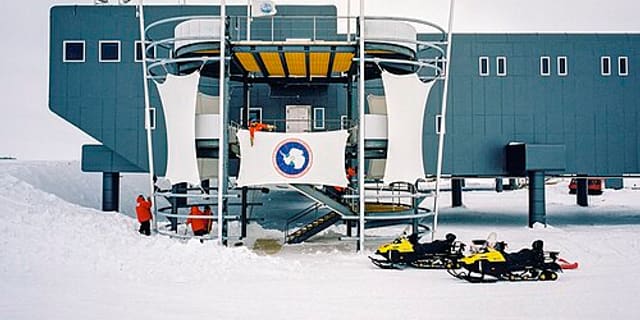
ASTEP is a 40-centimetre optical telescope operating at Concordia Station, the French–Italian research base on the high Antarctic plateau at Dome C, one of the most extreme and remote places any astronomical instrument has ever been installed.
About ASTEP, Concordia Station
ASTEP — short for the Antarctic Search for Transiting ExoPlanets — is a 40 cm optical telescope built to hunt for exoplanets by watching stars dim as planets pass in front of them. It was developed by the Fizeau and Cassiopée laboratories of the Observatoire de la Côte d'Azur, associated with the University of Nice-Sophia Antipolis, and was installed at Dome C during the southern-hemisphere summer of 2009–2010. The telescope's structure uses carbon fibre for stability, and its optics and detectors sit inside a thermally regulated enclosure designed to keep working at temperatures as low as -80°C (-110°F).
Telescopes & research
ASTEP's mission is to test how well continuous, uninterrupted observation from the Antarctic plateau can detect transiting exoplanets — objects such as the hot Jupiter WASP-19b have been observed with it. Because the site sits far from any city and above much of the atmosphere's turbulence, Concordia offers months of near-continuous winter darkness, dry air, and unusually stable seeing, conditions astronomers elsewhere can rarely get. Observers on the other side of the world send ASTEP its nightly target list; the telescope then points and exposes automatically, with data reduced on-site before being relayed to Europe.
Location & getting there
Concordia Station sits at Dome C on the Antarctic plateau, at an elevation of roughly 3,233 metres, about 1,100 km inland from the coast and from the nearest other research bases. It is jointly run by France's Institut polaire français (IPEV) and Italy's Programma Nazionale di Ricerche in Antartide (PNRA), and has been continuously staffed since 2005. This is one of the most isolated inhabited places on Earth, reachable only by specially equipped aircraft during the short Antarctic summer season.
Visiting Concordia Station
Concordia is a working scientific research station, not a tourist destination — access is limited to scientists, engineers, and support staff on approved research programmes, and getting there requires institutional sponsorship and Antarctic logistics support. There is no public visiting programme or ticketed access of any kind.
See your named star from here
You'll never book a personal visit to Concordia, but the same coordinates ASTEP tracks apply everywhere else the sky is visible. Name a star to receive its right ascension and declination, then find an observatory near you with a telescope that can be pointed at it.
Opening hours and public-visit programs vary by season. Check Google Maps for current times before you travel.
Institutional and reference sources used to verify this guide.
Satellite imagery: Esri, Maxar, Earthstar Geographics

 1,656 kmResearch
 1,658 km