
Arecibo Observatory

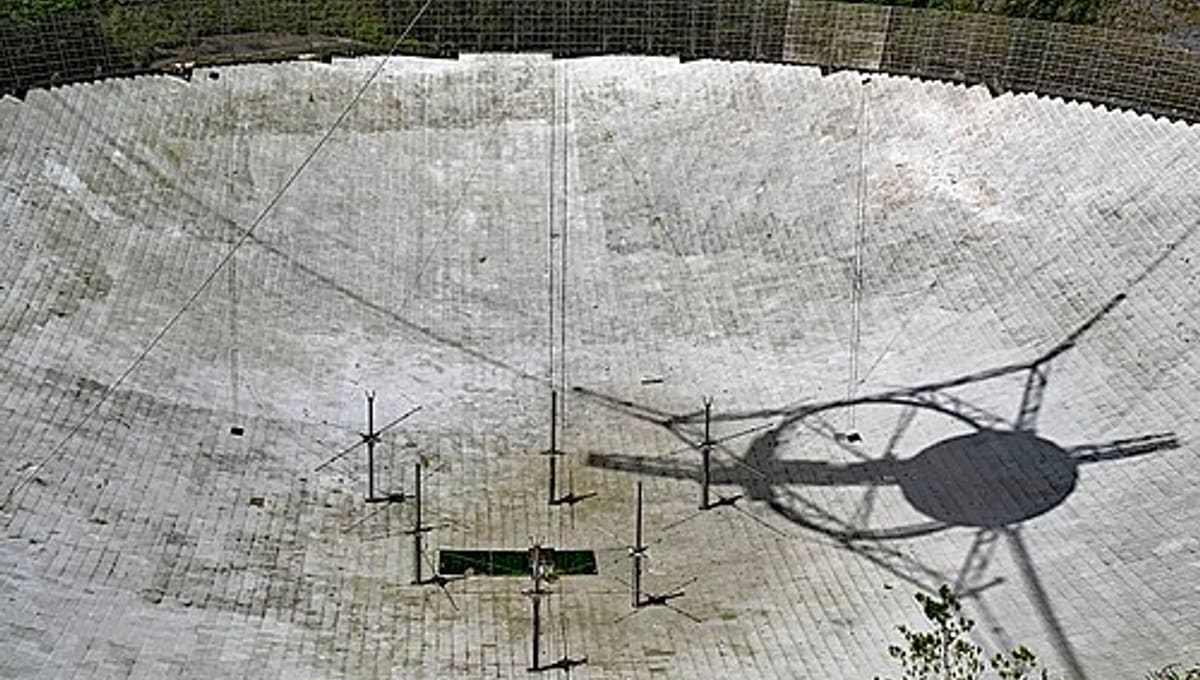
Image: Wikimedia Commons
Arecibo Observatory, also known as the National Astronomy and Ionosphere Center (NAIC), stands as one of astronomy's most significant research facilities in Arecibo, Puerto Rico. Though its main telescope is no longer operational, the site continues to serve science and education through its visitor centre and remaining facilities.
About Arecibo Observatory
The observatory is owned by the US National Science Foundation and operated collaboratively to support astronomical research, atmospheric science, and planetary studies. It was a major centre for radio astronomy, radar research on Solar System objects, and ionospheric investigations.
History
Arecibo Observatory was completed in 1963 with the construction of its iconic 305-metre (1,000 ft) spherical reflector dish - the world's largest single-aperture telescope for 53 years until surpassed by FAST in China in 2016. The facility revolutionized radio astronomy and made major contributions to pulsar research, planetary science, and the search for extraterrestrial intelligence.
Telescopes & Research
The main Arecibo Telescope featured a cable-mount steerable receiver and radar transmitters mounted 150 metres above the dish. The observatory also operated a smaller radio telescope and LIDAR facility. On 1 December 2020, the main telescope collapsed after support cables failed. The NSF has announced an educational facility will be established on the site, preserving the legacy of this pioneering observatory.
Location & Getting There
Located in Barrio Esperanza, Arecibo, Puerto Rico at 498 metres elevation, the site sits in a natural sinkhole that provided ideal conditions for the spheric reflector. The location's geology and atmospheric properties made it uniquely suited to radio astronomy.
Visiting Arecibo Observatory
The visitor centre remains operational and welcomes guests to learn about the observatory's historic contributions to science. For current visiting hours, tours, and admission information, check the official website at naic.edu or contact the facility directly before travelling.
See Your Named Star from Here
Radio astronomy facilities can detect and track celestial objects across the sky. A named star from our star-naming packages can be located using its RA and Dec coordinates. Explore our star catalogue to find your star and learn about observing it in the Puerto Rican sky.
Opening hours and public-visit programs vary by season. Check Google Maps for current times before you travel.
Institutional and reference sources used to verify this guide.
Satellite imagery: Esri, Maxar, Earthstar Geographics

 1,631 kmPlanetarium
 1,811 kmPlanetarium
 1,886 km