
Algonquin Radio Observatory

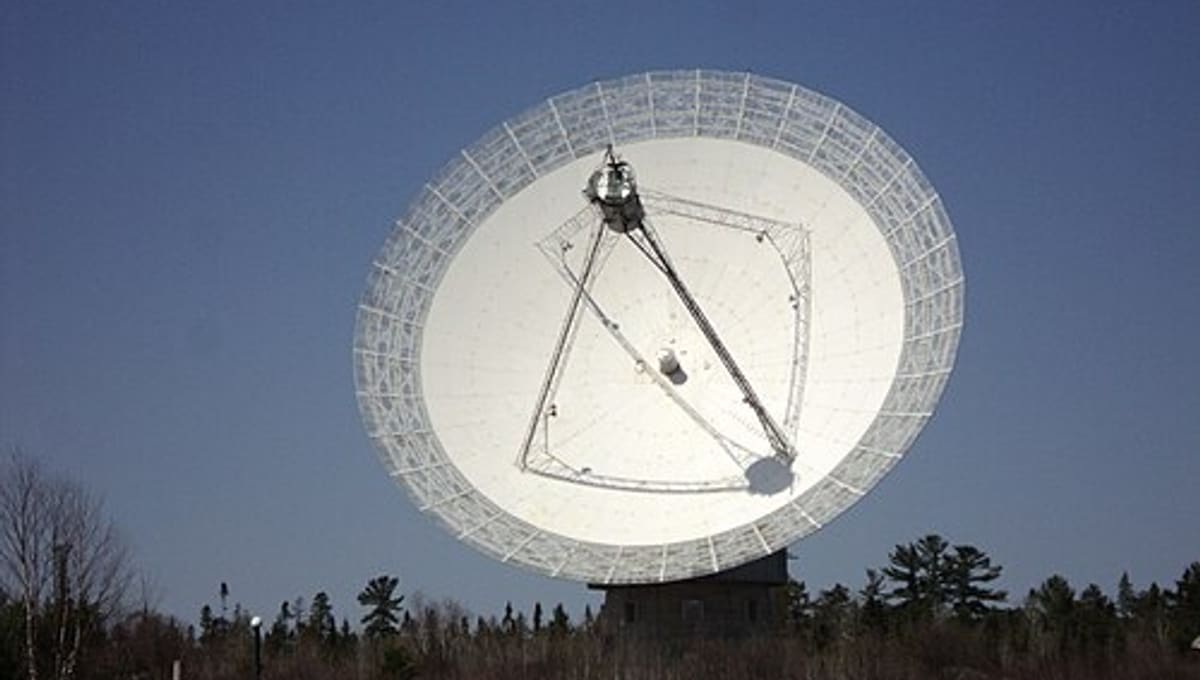
Image: Wikimedia Commons
Tucked into Algonquin Provincial Park in Ontario, Canada, the Algonquin Radio Observatory (ARO) has listened to the radio sky from one of the country's quietest sites for more than six decades.
About Algonquin Radio Observatory
ARO opened in 1959 so the National Research Council of Canada could run radio experiments away from the interference of Ottawa. Its main instrument for most of its history has been the 46-metre Algonquin radio telescope, selected for the site in 1962, alongside an earlier 10-metre dish installed in 1961.
History
Through the 1960s and 70s the site hosted a growing suite of instruments, including a hydrogen maser for deep-space telemetry, a 32-dish solar-observing array, and an 18-metre telescope from the University of Toronto. Operations passed from the NRC to the Institute for Space and Terrestrial Science (later CRESTech) in the late 1980s, and since 2007 the observatory has been run by Thoth Technology Inc.
Telescopes & research
Today the 46m dish is used mainly for very long baseline interferometry (VLBI) in geodesy, as a Global Positioning System reference site, and for satellite downlink work. Earlier decades of solar-array and telemetry research have given way to this more specialised geodetic and space-tracking role.
Location & getting there
The observatory overlooks Lake Travers deep inside Algonquin Provincial Park, one of Ontario's most remote and radio-quiet wilderness areas, making it as much a retreat into the park's forests and lakes as a visit to a working scientific site.
Visiting Algonquin Radio Observatory
For the first time in its history, ARO is now open to visitors under operator Thoth Technology, with guided tours covering the radio telescope, the atomic clock, and the site's history, plus lodging with a private beach, canoes and kayaks. Check the observatory's official website for current tour availability before travelling.
See your named star from here
ARO's giant dish studies the radio sky rather than visible starlight, but the coordinates behind a star named through Star Register work the same way across the electromagnetic spectrum. Name a star or browse the star catalogue to find one you could point an optical telescope toward on a clear Algonquin night.
Opening hours and public-visit programs vary by season. Check Google Maps for current times before you travel.
Institutional and reference sources used to verify this guide.
Satellite imagery: Esri, Maxar, Earthstar Geographics

 256 km
 257 km
Killarney Provincial Park Observatory
Observatory in Killarney Provincial Park, Ontario, Canada