
David Dunlap Observatory

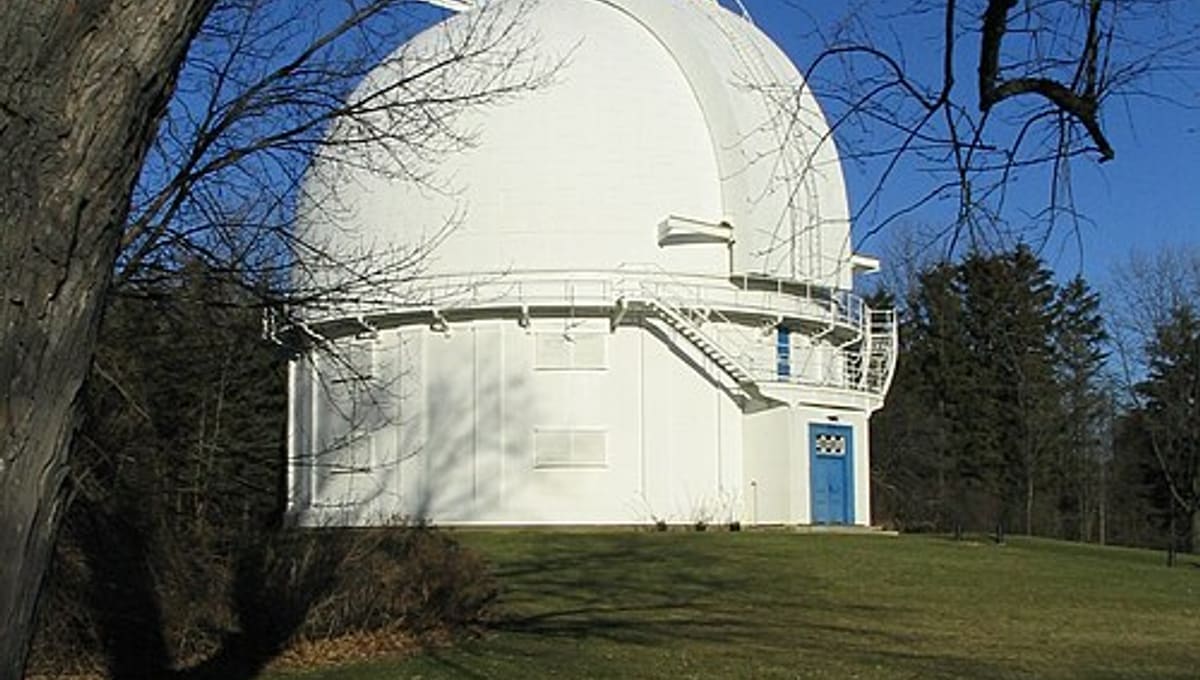
Image: Wikimedia Commons
The David Dunlap Observatory sits on a hilltop in Richmond Hill, Ontario, just north of Toronto, home to the largest telescope in Canada. Opened in 1935, it produced decades of major astronomical research before becoming a National Historic Site now run by the City of Richmond Hill for public benefit.
About David Dunlap Observatory
The observatory was built at the initiative of astronomer Clarence Chant, with financial backing from the family of businessman David Alexander Dunlap after his death in 1924. Established in 1935 at an elevation of about 224 meters, it was owned and operated by the University of Toronto until 2008, when the university transferred the site to the City of Richmond Hill, which now manages it as a combination of heritage preservation, public recreation space, and a celebration of the site's astronomical history.
History
David Dunlap Observatory quickly became one of the world's leading research sites thanks to its 74-inch (1.88 meter) reflector telescope, the second-largest in the world when it opened and still the largest in Canada today. Researchers there made major contributions to astrophysics, including astronomer Thomas Bolton's 1972 observations that helped confirm the existence of black holes through Cygnus X-1, and Helen Sawyer Hogg's extensive cataloguing of star clusters. In recognition of this legacy, the site was designated a National Historic Site of Canada on July 31, 2019.
Telescopes & research
Beyond the landmark 74-inch reflector, several other telescopes are located on the grounds, supporting the observatory's decades of work in stellar astrophysics. The scientific program continues today through the University of Toronto's Dunlap Institute for Astronomy & Astrophysics, a research institute established in 2008 to carry the observatory's legacy forward even after the university stopped operating the physical site.
Location & getting there
The observatory sits at 123 Hillsview Drive in Richmond Hill, Ontario, a short distance north of Toronto in Canada's North America region. Though the site is on a hill, it's relatively close to sea level and now surrounded by suburban development, which has reduced its usefulness for cutting-edge optical research compared to more remote observatories, even as it remains a well-loved local landmark.
Visiting David Dunlap Observatory
The City of Richmond Hill runs public tours of the observatory on Saturdays from May through October, along with summer weekend talks and family events. Details and current schedules are available through the City of Richmond Hill's website before planning a visit.
See your named star from here
Canada's largest telescope has spent decades finding faint, faraway objects using nothing more than precise coordinates, exactly what you get when you name a star. Name a star through star-register.eu and you'll receive its right ascension and declination, ready to bring along on a visit to David Dunlap Observatory or share with any other telescope. Explore the stars already named in our catalogue.
Opening hours and public-visit programs vary by season. Check the official website and Google Maps for current times before you travel.
Institutional and reference sources used to verify this guide.
Satellite imagery: Esri, Maxar, Earthstar Geographics

 12 kmResearch
C. E. K. Mees Observatory
astronomical observatory at the University of Rochester