
Abisko Magnetic Observatory
Satellite imagery: Esri, Maxar, Earthstar Geographics
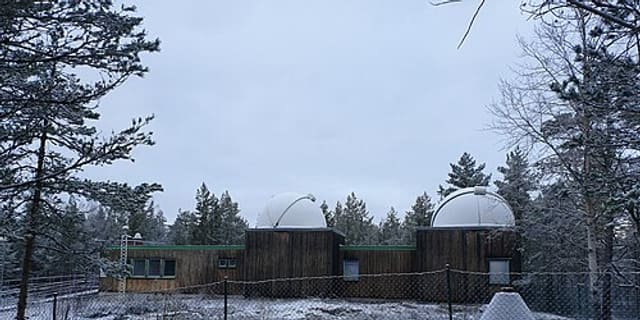
Abisko Magnetic Observatory (ABK) is a geophysical research station located in Abisko, Swedish Lapland, approximately 200 kilometres north of the Arctic Circle at 385 metres elevation on the south shore of Lake Torneträsk. The facility continuously monitors variations in Earth's geomagnetic field as part of international scientific networks.
About Abisko Magnetic Observatory
The observatory operates as one of three permanent magnetometer stations in Sweden contributing to global geomagnetic monitoring. Data from Abisko are reported in near-real-time to international datacentres including Intermagnet and the World Data Center C2, making it a vital node in the global geophysical monitoring network.
Scientific Research
Abisko serves as a reference station for understanding Earth's magnetic field variations and ionospheric disturbances. The location, approximately 200 kilometres within the Arctic Circle, is strategically positioned to study high-latitude geomagnetic phenomena. The observatory historically served as a permanent magnetometer station during the International Magnetosphere Study and continues as a permanent AE magnetometer reference site.
Location & Getting There
Positioned in Swedish Lapland, the observatory sits at the Abisko Scientific Research Station, a broader research facility hosting approximately 70 to 80 scientific projects annually. The Arctic location provides unique access to phenomena like aurora and magnetic storm events.
Research Collaboration
The Abisko facility integrates with the Abisko Scientific Research Station, which coordinates multidisciplinary research ranging from ecology and climate to physical geography and space physics, making it a node in broader Scandinavian and European scientific infrastructure.
Name a star of your own
Whether or not you can visit Abisko Magnetic Observatory, you can dedicate a real, visible star through Star-Register. Name a star to receive its exact coordinates, or browse the star catalogue to look one up.
Opening hours and public-visit programs vary by season. Check Google Maps for current times before you travel.
Institutional and reference sources used to verify this guide.
Satellite imagery: Esri, Maxar, Earthstar Geographics

 866 km
 893 km