
Würzburg University Observatory
Satellite imagery: Esri, Maxar, Earthstar Geographics
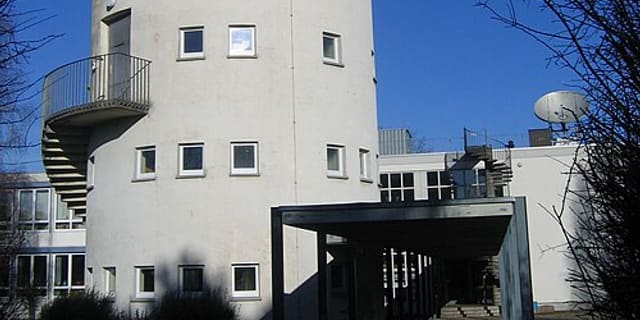
Würzburg University Observatory has a long history in Bavaria, Germany, tracing back more than 260 years to its earliest home in a church tower in the city.
About Würzburg University Observatory
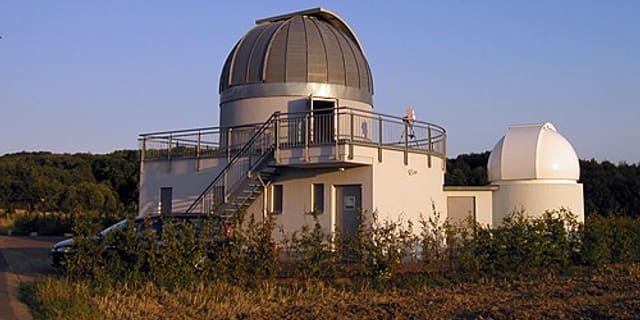
Today's facility, the Hans Haffner Observatory, sits about 10 kilometres west of Würzburg and is run in cooperation with the Chair of Astronomy at the University of Würzburg. It's named after astronomer Hans Haffner (1912-1977) and carries the Minor Planet Center observatory code D69.
History
The university's astronomical tradition dates back to 1757, when it kept an observatory in the tower of the Neubaukirche church, from where the Transit of Venus was observed in 1761. A later facility in the Keesburg district was abandoned in the 1990s, before the current Hans Haffner Observatory was built in 2009. Since the start of 2024, a new telescope has also been under construction at the university's Hubland Campus, as part of the KI-SENS project for aerospace teaching and research.
Telescopes & research
The Hans Haffner Observatory's main instrument is a 50-centimetre reflector telescope, used for lectures, seminars and astronomical practical courses for pupils, students and university staff.
Location & getting there
The observatory sits at an elevation of around 186 metres in the countryside west of Würzburg, in Germany's Bavaria region. Use the map and directions button on this page to plan your route from the city.
Visiting Würzburg University Observatory
Because the observatory is primarily used for university teaching, public visits are generally arranged around lectures, seminars and courses run by the Chair of Astronomy. Check with the University of Würzburg for any public open-house events before travelling.
See your named star from here
A star named through star-register.eu comes with exact coordinates that a telescope like the Hans Haffner Observatory's 50-centimetre reflector could, in principle, be pointed at. Take a look at our catalogue of previously named stars.
Opening hours and public-visit programs vary by season. Check Google Maps for current times before you travel.
Institutional and reference sources used to verify this guide.
Satellite imagery: Esri, Maxar, Earthstar Geographics

 2 kmPublic
 34 kmPublic