
Bamberg observatory
Satellite imagery: Esri, Maxar, Earthstar Geographics
Bamberg observatory, formally the Dr. Karl Remeis-Sternwarte, has studied the sky from Bamberg, Bavaria, Germany, since the late 19th century, and remains one of the country's few astronomical institutes still housed in its original period buildings.
About Bamberg observatory
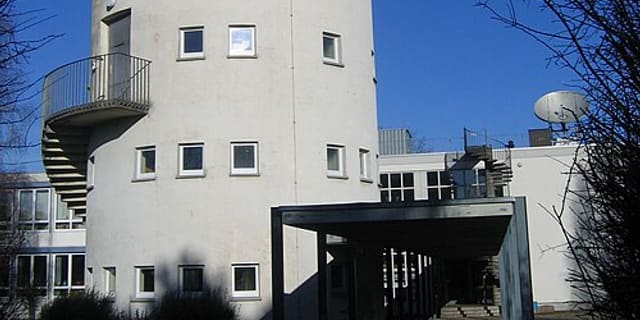
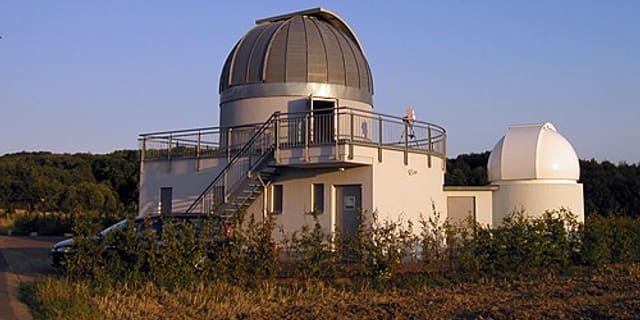
The observatory is one of only three astronomical institutes in Bavaria and one of only two modern astronomical institutes in Germany still working from original 19th-century buildings. Its site includes a main building and an observation building with a meridian hall and two domes set on an east–west line. Since 2007 it has formed part of the Erlangen Centre for Astroparticle Physics (ECAP), combining neutrino physics with X-ray and gamma-ray astronomy, and today the institute employs more than 50 people, including three professors, postdoctoral researchers, and students.
History
The observatory was founded in 1889 as a private institution by Dr. Karl Remeis, a wealthy lawyer and amateur astronomer. It became part of the University of Erlangen-Nuremberg in 1962, when it was reorganised as an Astronomical Institute.
Telescopes & research
Bamberg observatory researches multiwavelength and stellar astronomy, including X-ray astronomy, using instruments that include a 25 cm telescope, a 40 cm telescope (CHT), a 50 cm telescope (EHT), and a small radio telescope. Its collections hold historical telescopes and instruments spanning the 19th and 20th centuries, including two Utzschneider and Fraunhofer telescopes, meteorites, historic printing plates, a historic Schmidt camera, and more than 30,000 glass photographic plates from northern and southern sky surveys. Research is funded in part by the German Research Foundation and the European Space Agency.
Location & getting there
The observatory sits in Bamberg, Bavaria, in southern Germany. Use the map and directions on this page to plan your route into the city.
Visiting Bamberg observatory
As a university research institute with historical collections, check the observatory's current opening times and any guided-tour arrangements before travelling.
See your named star from here
An institute with more than a century of stellar astronomy behind it is a fitting place to look for a newly named star. Name a star and check the catalogue for its exact coordinates.
Opening hours and public-visit programs vary by season. Check Google Maps for current times before you travel.
Institutional and reference sources used to verify this guide.
Satellite imagery: Esri, Maxar, Earthstar Geographics

 69 kmPublic
 84 kmPublic